
info@smarledlighting.com
+86 20 38466982
Toggle Navigation


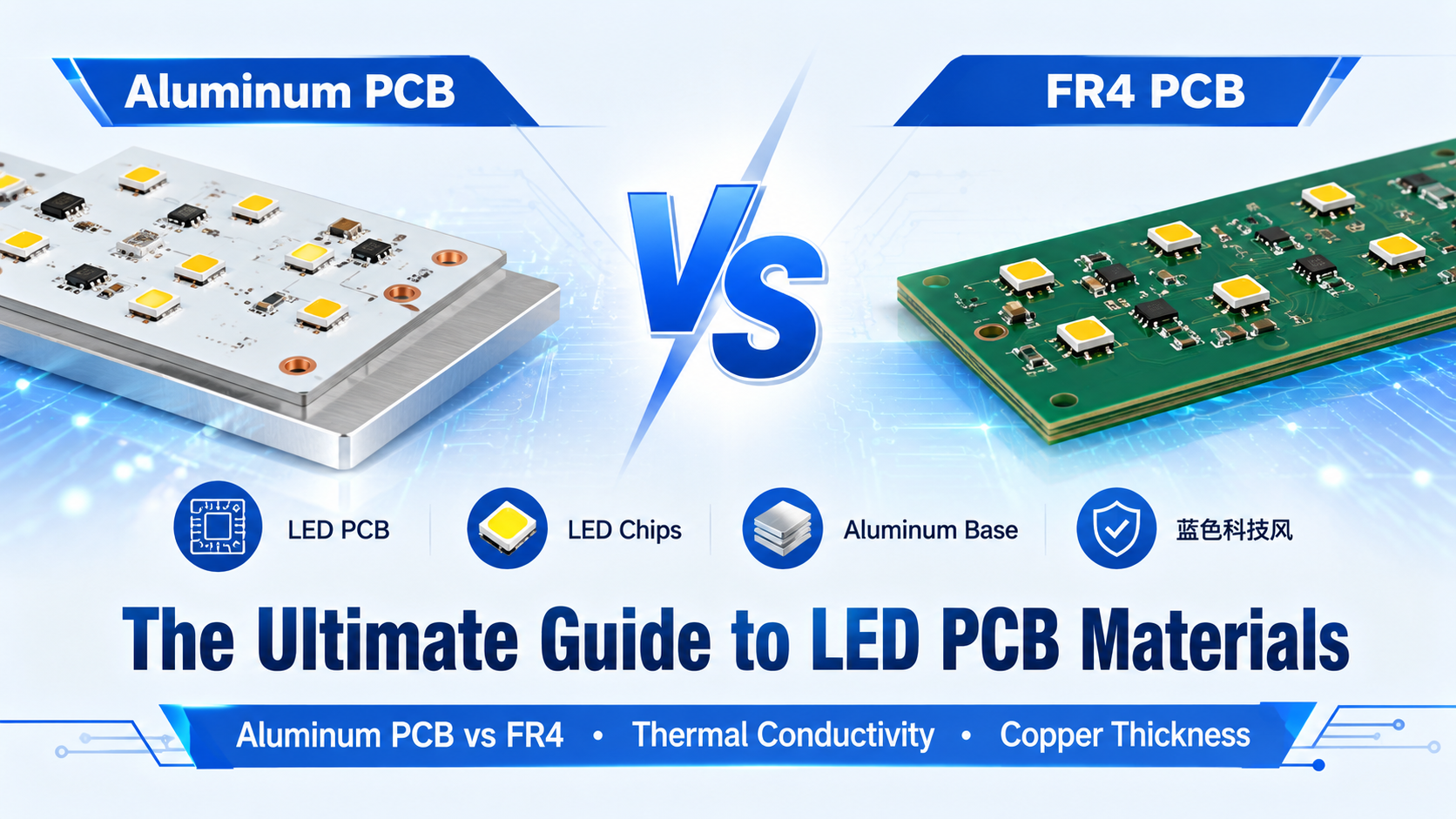
Choosing the right LED PCB material is one of the most important decisions in LED lighting design. While LED chips and drivers often receive the most attention, the PCB plays an equally critical role in determining thermal performance, product reliability, luminous efficiency, and service life.
A poorly selected PCB material can increase LED junction temperature, accelerate lumen depreciation, shorten product lifetime, and even lead to premature failures. In contrast, a properly designed Aluminum PCB (MCPCB) can significantly improve heat dissipation, stabilize electrical performance, and reduce long-term maintenance costs.
Many lighting manufacturers assume that higher thermal conductivity or thicker copper always delivers better performance. In reality, the best PCB design depends on multiple engineering factors, including power level, heat generation, installation environment, product lifetime targets, certification requirements, and overall project budget.
In this ultimate guide, we'll explain how to choose the most suitable LED PCB material for different lighting applications, compare Aluminum PCB vs FR4 PCB, discuss thermal conductivity and copper thickness, and share practical engineering insights to help lighting manufacturers make better design decisions.
Why LED PCB Material Matters
An LED PCB is far more than a mechanical platform for mounting LEDs. It serves as the thermal pathway that transfers heat generated by LED chips into the heat sink and surrounding environment.
If heat cannot escape efficiently, junction temperature rises rapidly. Even premium LEDs from leading manufacturers can experience faster lumen depreciation, color shift, and reduced lifetime when operated under excessive temperatures.
The PCB directly influences several key performance indicators:
Heat dissipation efficiency
LED junction temperature
Product lifetime
Luminous efficacy
Reliability
Mechanical stability
Manufacturing consistency
Long-term maintenance cost
For commercial lighting projects, selecting the correct PCB material often produces greater long-term value than choosing a slightly cheaper PCB during procurement.
SMAR Engineering Experience
In many customer projects, our engineering team has found that thermal optimization of the PCB often delivers a greater improvement in product reliability than upgrading to more expensive LED chips. A balanced thermal design frequently provides the best return on investment.
What Is an LED PCB?
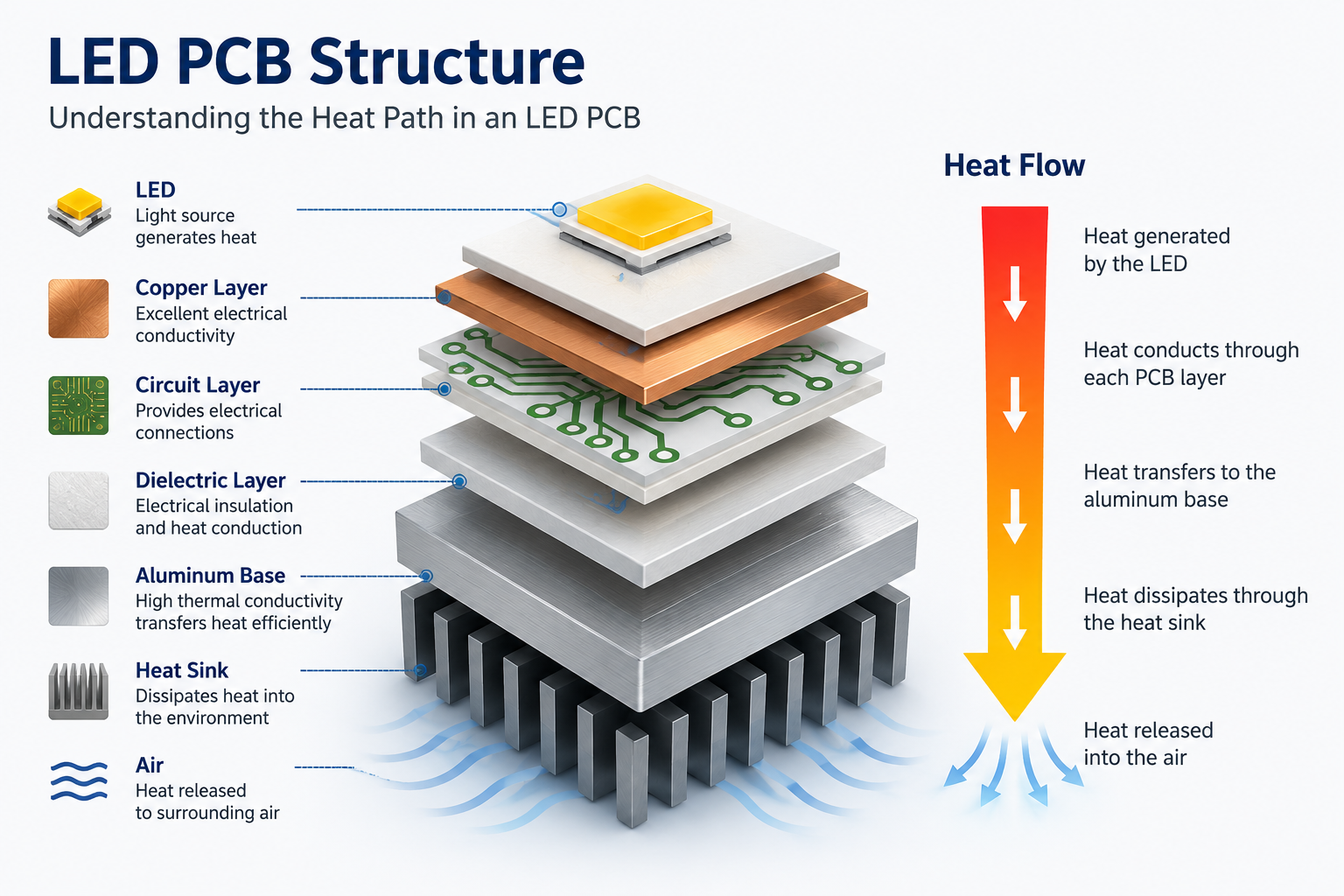
An LED PCB (Light Emitting Diode Printed Circuit Board) is a specially designed circuit board used to mount LEDs and electronic components while efficiently transferring heat away from the light source.
Unlike ordinary PCBs used in consumer electronics, LED PCBs must continuously operate under elevated temperatures for thousands of hours. Their thermal performance directly affects LED stability and lifetime.
An LED PCB typically performs four essential functions:
Supporting LED chips and electronic components
Providing electrical connections
Conducting heat away from LEDs
Improving structural stability and long-term reliability
Today, Metal Core Printed Circuit Boards (MCPCBs)—particularly Aluminum PCBs—have become the preferred choice for most professional lighting applications because of their superior thermal conductivity and cost-effectiveness.
Types of LED PCB Materials
Different lighting applications require different PCB materials. The most common options include:
Aluminum PCB (MCPCB)
Aluminum PCB is the industry standard for commercial LED lighting.
Advantages include:
Excellent heat dissipation
Lower LED operating temperature
Longer product lifetime
Better reliability
High mechanical strength
Suitable for medium and high-power lighting
Typical applications:
LED panel lights
Downlights
Linear lights
Flood lights
High bay lighting
Street lighting
Industrial luminaires
FR4 PCB
FR4 is a fiberglass-reinforced epoxy laminate widely used in consumer electronics.
Advantages include:
Lower manufacturing cost
Easy processing
Suitable for complex multilayer circuits
Good electrical insulation
Typical applications:
Decorative lighting
Indicator lights
Low-power LED products
Consumer electronics
However, FR4 has significantly lower thermal conductivity than Aluminum PCB, making it unsuitable for many high-power lighting products.
Copper Core PCB
Copper Core PCB offers even better thermal performance than Aluminum PCB.
Advantages:
Extremely high thermal conductivity
Excellent current carrying capability
Outstanding heat spreading
Typical applications:
Automotive lighting
UV LED systems
High-power industrial lighting
Medical equipment
Its higher manufacturing cost generally limits its use to specialized applications.
Ceramic PCB
Ceramic substrates provide exceptional thermal performance while offering excellent electrical insulation.
Advantages:
Outstanding heat dissipation
Excellent dimensional stability
High temperature resistance
Suitable for harsh environments
Applications:
Aerospace
Medical devices
High-end industrial equipment
Automotive electronics
Although ceramic PCBs deliver superior performance, their cost is substantially higher than Aluminum PCBs.
Aluminum PCB vs FR4 PCB
For most lighting manufacturers, the real decision comes down to Aluminum PCB vs FR4 PCB.
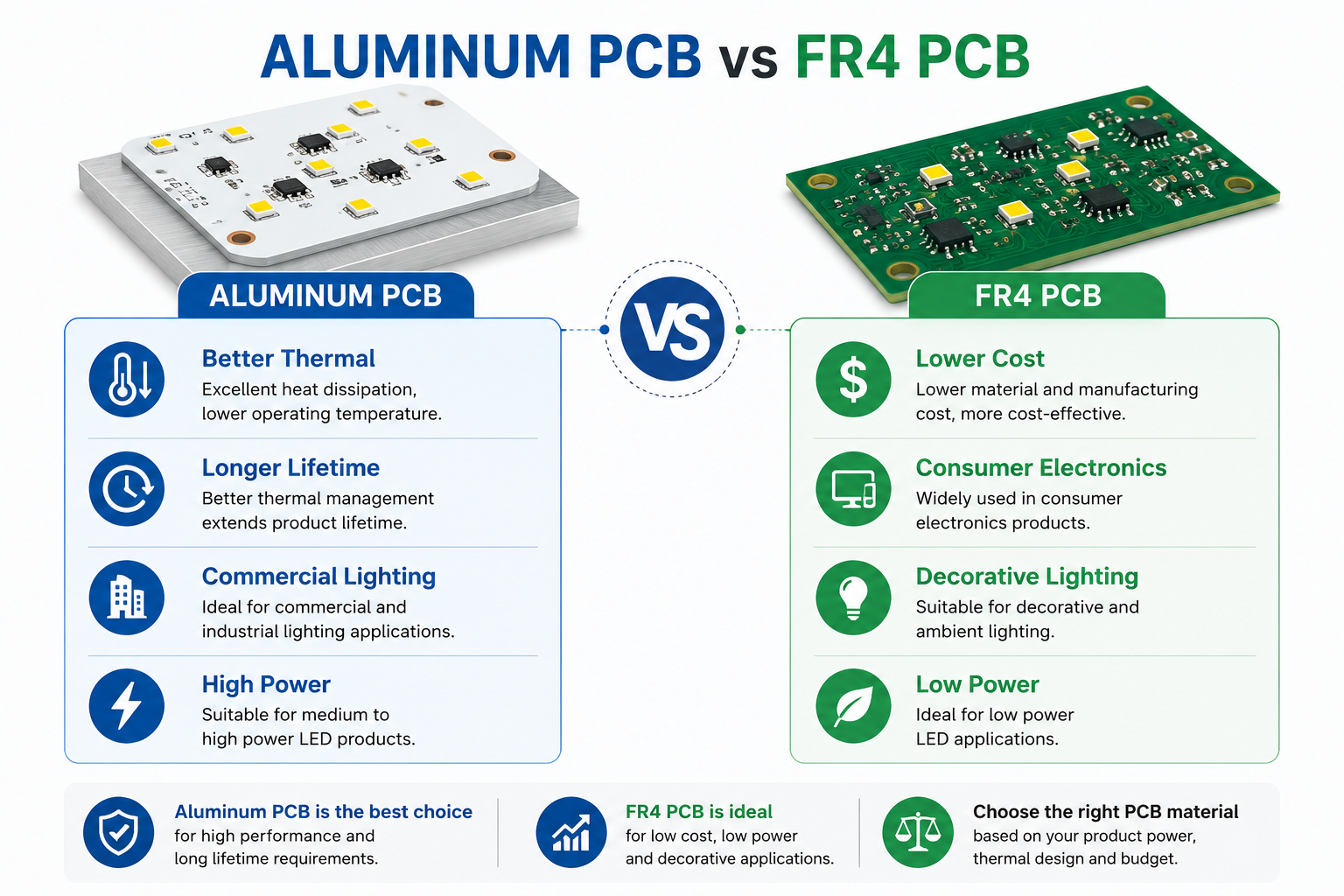
Although FR4 may reduce the initial PCB cost, the overall project cost can increase because of higher operating temperatures, additional heat sink requirements, and shorter product lifetime.
For most professional lighting applications, Aluminum PCB remains the optimal balance between performance and cost.
SMAR Engineering Experience
Many customers initially request FR4 PCBs to reduce costs. After reviewing the thermal simulation, however, we often recommend Aluminum PCB because it allows a simpler fixture structure and significantly improves long-term reliability.
Understanding Thermal Conductivity: 1W/mK vs 2W/mK vs 3W/mK
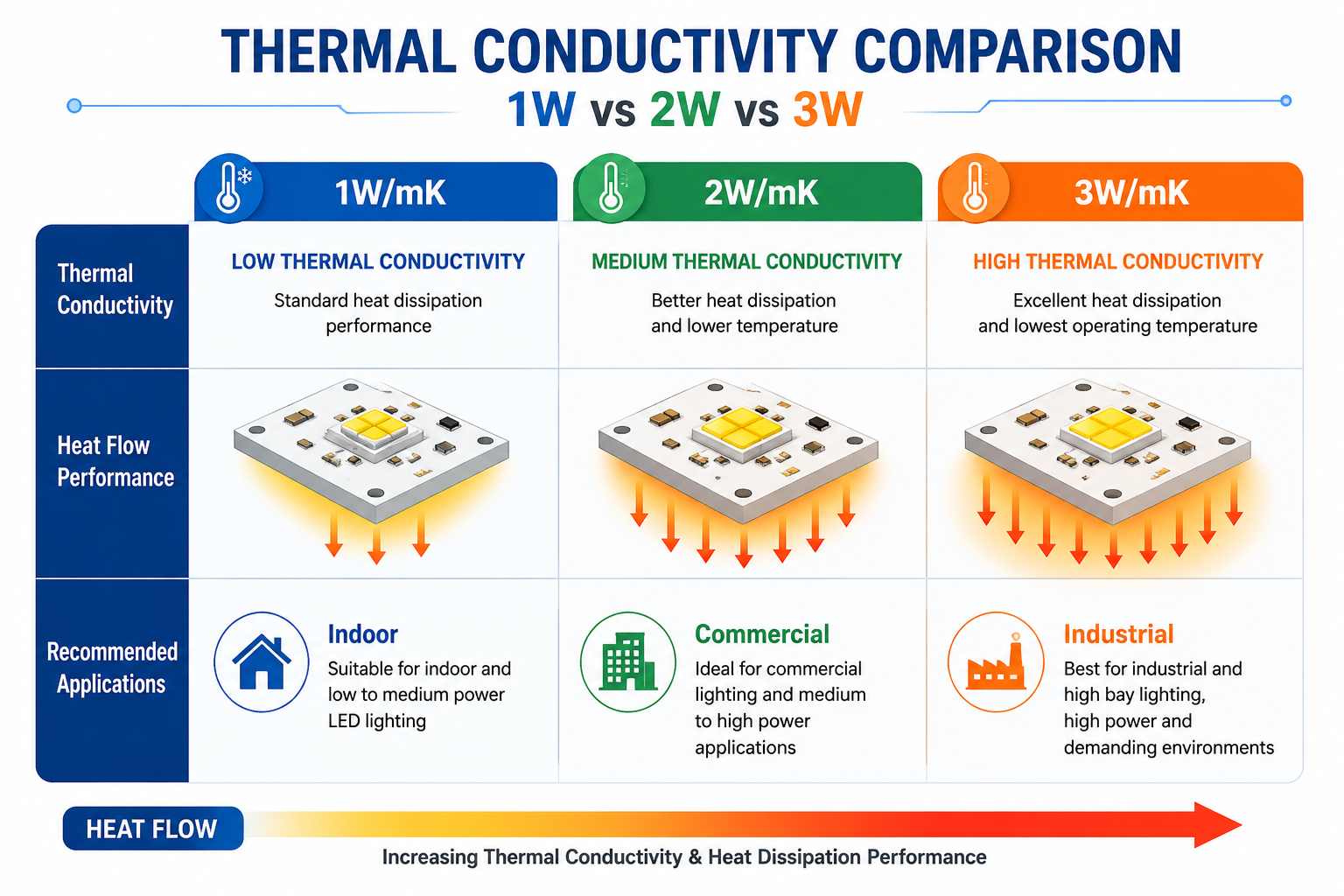
Thermal conductivity measures how efficiently an aluminum PCB transfers heat away from LEDs. A higher thermal conductivity value generally improves heat dissipation, lowers operating temperature, and extends the lifetime of LED lighting products.
For most indoor lighting applications such as panel lights and linear lights, 1W/mK aluminum PCB is usually sufficient. 2W/mK provides better thermal management for commercial downlights and medium-power fixtures, while 3W/mK is recommended for demanding industrial and high-power lighting where maximum heat dissipation is required.
| Thermal Conductivity | Typical Applications | Recommendation |
|---|---|---|
| 1W/mK | Indoor lighting, panel lights, linear lights | Most cost-effective |
| 2W/mK | Commercial lighting, downlights | Better thermal performance |
| 3W/mK | Industrial lighting, high-power LED | Maximum heat dissipation |
Copper Thickness: 1oz vs 2oz vs 3oz
Copper thickness affects both electrical current carrying capacity and heat spreading performance.
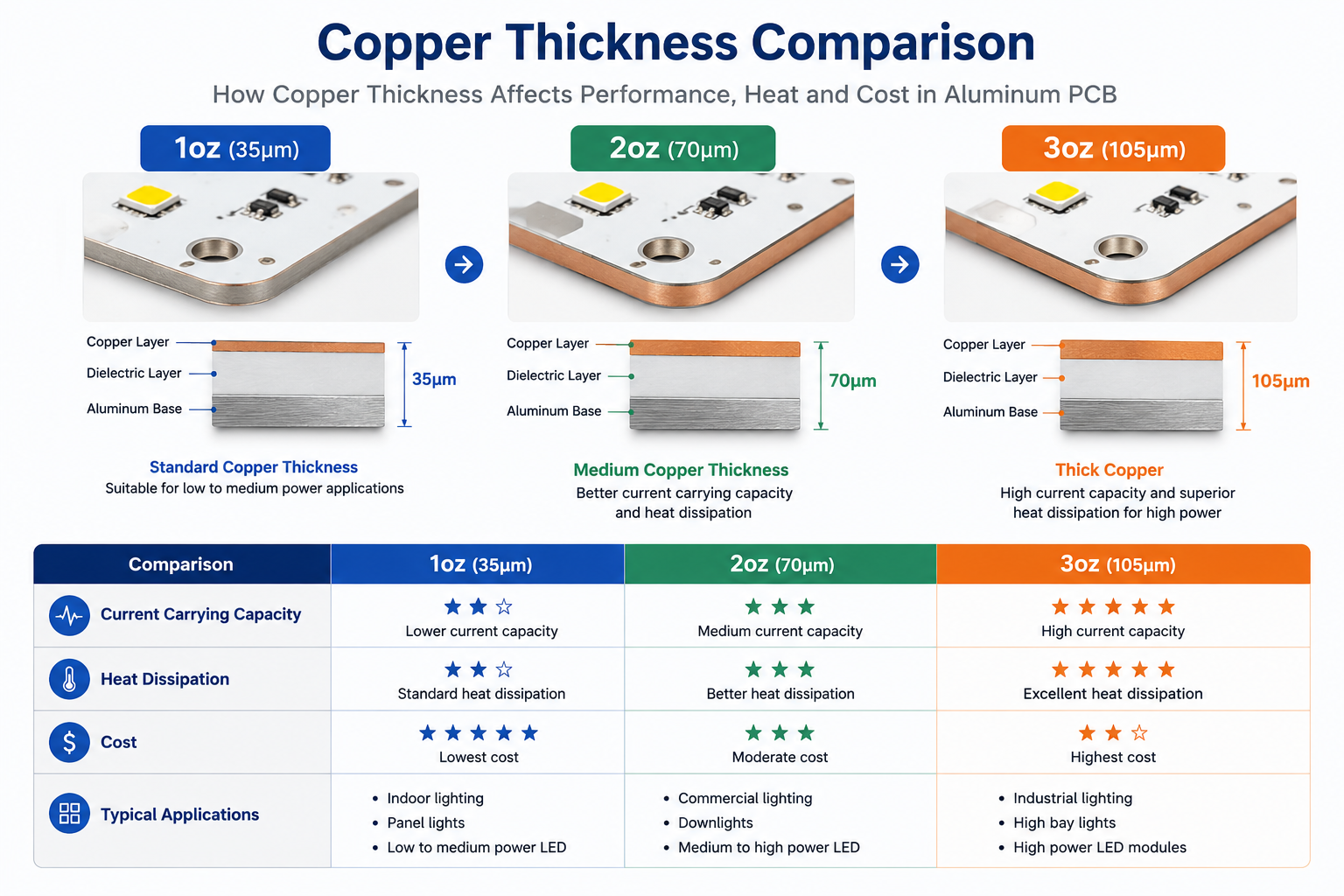
The most common options include:
1oz Copper
Recommended for:
Standard LED modules
Panel lights
Linear lighting
Downlights
Advantages:
Lower cost
Easy manufacturing
Suitable for most lighting products
2oz Copper
Ideal for:
High-current LED drivers
High-power lighting
Industrial applications
Outdoor luminaires
Advantages:
Better current carrying capability
Reduced voltage drop
Improved heat distribution
3oz Copper
Typically reserved for:
Specialized industrial equipment
Heavy-current applications
Automotive lighting
High-power commercial systems
Increasing copper thickness can improve performance, but it also increases PCB cost and manufacturing complexity. Selecting the appropriate thickness should always be based on electrical load and thermal analysis rather than assumptions.
How PCB Material Affects LED Lifetime
LED lifetime is closely linked to operating temperature, and the PCB is one of the primary components responsible for controlling that temperature.
As heat travels from the LED chip through the solder joints, PCB, thermal interface material, heat sink, and finally into the surrounding air, every layer introduces thermal resistance. A poorly selected PCB increases this resistance, causing heat to accumulate around the LEDs.
Higher junction temperatures can lead to:
Faster lumen depreciation
Reduced luminous efficacy
Color shift over time
Driver stress
Earlier component aging
Increased maintenance costs
Shorter overall product lifetime
International standards such as LM-80 and TM-21 provide methods for evaluating lumen maintenance and projecting LED lifetime, but achieving those lifetime targets also depends on effective thermal management throughout the luminaire—not just on the LED chips themselves.
SMAR Engineering Experience
In our custom LED PCB projects, thermal optimization often begins with the PCB rather than the LED package. By selecting appropriate thermal conductivity, copper thickness, and board layout, we frequently reduce operating temperatures without increasing overall project cost.
The 8 Factors When Selecting an LED PCB Material
Selecting an LED PCB involves much more than comparing prices or choosing the highest thermal conductivity. Professional lighting manufacturers evaluate multiple engineering factors to achieve the best balance between performance, reliability, and total project cost.
1. Operating Power
Power output is the starting point of PCB selection.
As LED power increases, more heat is generated, requiring better thermal management. Low-power residential lighting often performs well with a standard 1W/mK Aluminum PCB, while industrial or outdoor luminaires usually benefit from higher thermal conductivity and optimized PCB layouts.
2. Thermal Requirements
Every lighting application has a different thermal environment.
Consider:
Ambient temperature
Enclosure ventilation
Heat sink capacity
Continuous operating hours
Junction temperature targets
Good thermal management extends LED lifetime and helps maintain lumen output over many years.
SMAR Engineering Experience
Rather than recommending the highest thermal conductivity for every project, our engineers perform thermal analysis based on fixture structure and operating conditions. In many indoor lighting applications, optimized system design provides better value than simply increasing PCB specifications.
3. Mechanical Design
PCB dimensions directly affect fixture design.
Custom PCB shapes can reduce:
Assembly complexity
Additional brackets
Wiring length
Fastener quantity
This simplifies production while improving manufacturing consistency.
4. Copper Thickness
Copper thickness should match electrical requirements.
Higher current products benefit from thicker copper, but excessive copper increases manufacturing cost without proportional performance improvement.
Engineering optimization always seeks the best balance rather than maximum specifications.
5. Environmental Conditions
Outdoor products experience:
High temperatures
Rain
Humidity
UV exposure
Dust
These factors require more robust PCB materials than indoor applications.
Industrial lighting may also require better corrosion resistance and higher long-term stability.
6. Product Lifetime Target
Different markets expect different product lifetimes.
Residential lighting may target 20,000–30,000 hours.
Commercial lighting often requires 50,000 hours or more.
Municipal and industrial lighting projects may target 100,000-hour system reliability.
Longer lifetime expectations generally require better PCB materials and thermal management.
7. Certification Requirements
PCB selection also affects compliance with international regulations.
Depending on the market, products may need to comply with:
IEC 60598
RoHS
REACH
CE
UL
ErP Ecodesign requirements
Choosing suitable materials early in the design stage helps simplify certification and reduce redesign costs.
8. Total Project Cost
Professional buyers increasingly evaluate projects using Total Cost of Ownership (TCO) rather than PCB price alone.
A slightly more expensive Aluminum PCB may reduce:
Heat sink size
Assembly time
Warranty claims
Maintenance costs
Product failures
As a result, the total project cost is often lower than using a cheaper PCB.
Real-World Application Recommendations
Different lighting applications require different PCB solutions. Selecting materials according to actual operating conditions improves both reliability and cost efficiency.
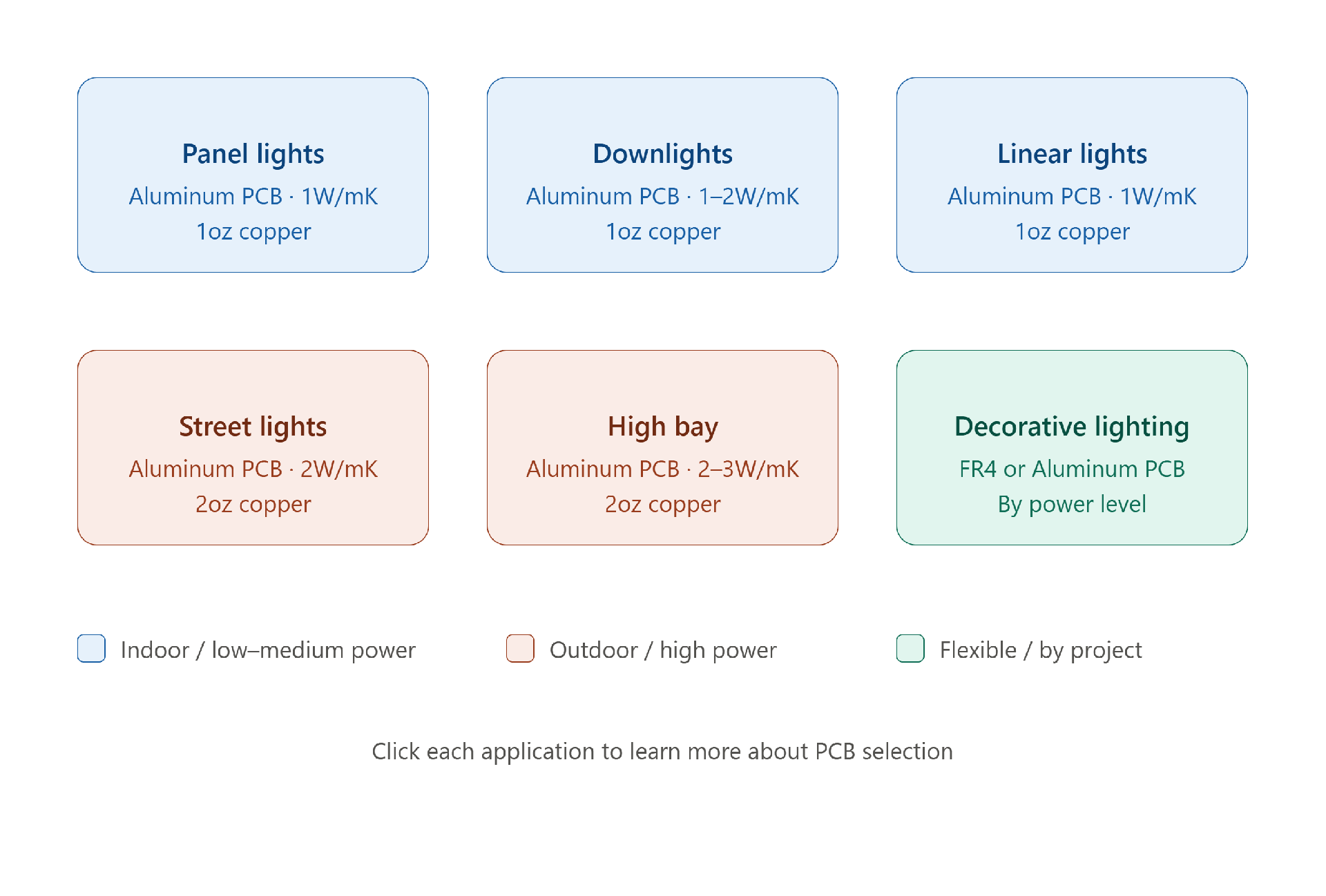
LED Panel Lights
Recommended Configuration
Aluminum PCB
1W/mK thermal conductivity
1oz copper
Panel lights typically distribute heat over a large aluminum frame, making 1W/mK sufficient for most commercial installations.
LED Downlights
Recommended Configuration
Aluminum PCB
1W/mK or 2W/mK
1oz copper
Compact fixture designs often generate higher internal temperatures, particularly in recessed ceilings. Higher wattage models usually benefit from improved thermal conductivity.
Linear Lighting
Recommended Configuration
Aluminum PCB
1W/mK
1oz copper
Because linear fixtures offer a larger heat dissipation area, standard thermal conductivity is adequate for most indoor applications.
Street Lighting
Recommended Configuration
Aluminum PCB
2W/mK
2oz copper when necessary
Street lights operate for long periods under harsh outdoor environments. Better thermal performance improves lumen maintenance and long-term reliability.
High Bay & Industrial Lighting
Recommended Configuration
Aluminum PCB
2–3W/mK
2oz copper
Industrial facilities often operate lighting continuously. Optimized thermal management becomes essential for reducing maintenance costs.
Architectural & Decorative Lighting
Recommended Configuration
FR4 PCB or Aluminum PCB
Selection depends on:
LED power
Fixture size
Heat generation
Design complexity
Common PCB Material Selection Mistakes
Many purchasing decisions are based solely on PCB price. However, several common mistakes can significantly increase overall project costs.
Choosing FR4 for High-Power Lighting
Although FR4 reduces initial PCB cost, inadequate heat dissipation often leads to overheating and shorter product lifetime.
Assuming Higher Thermal Conductivity Is Always Better
Many buyers believe 3W/mK always outperforms 1W/mK.
In reality, proper fixture design often provides greater thermal improvement than simply increasing PCB conductivity.
Ignoring Copper Thickness
Insufficient copper may increase voltage drop and current density, affecting electrical performance.
Ignoring Complete Thermal Design
PCB performance depends on the entire thermal path:
LED Chip → Solder → PCB → Thermal Interface Material → Heat Sink → Ambient Air
Every component contributes to thermal resistance.
Comparing Only PCB Price
The PCB represents only one portion of the total lighting system cost.
Engineering optimization should evaluate:
Assembly
Certification
Reliability
Maintenance
Inventory
Warranty
rather than PCB cost alone.
How to Evaluate an LED PCB Before Mass Production
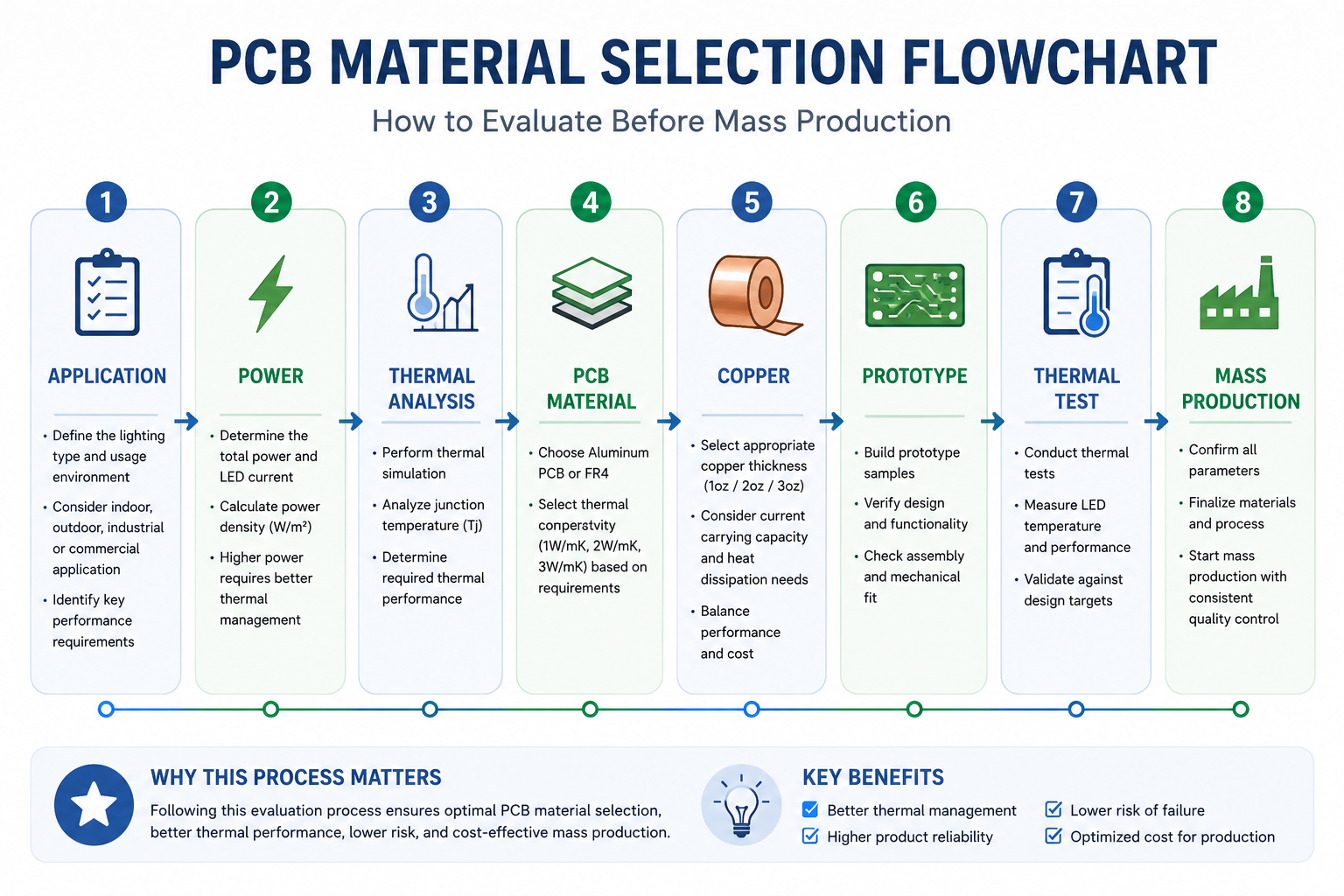
Selecting the right LED PCB material is a step-by-step engineering process rather than simply choosing the lowest-cost option. Before mass production, manufacturers should evaluate the lighting application, power level, thermal requirements, PCB material, copper thickness, prototype testing, and thermal performance. Following a structured evaluation process helps reduce design risks, improve product reliability, and lower the total manufacturing cost.
Frequently Asked Questions
Q1: What is the difference between Aluminum PCB and FR4 PCB for LED lighting?
Aluminum PCB (MCPCB) uses a metal base layer that conducts heat away from LED chips far more efficiently than FR4's fiberglass substrate. For medium and high-power lighting applications — panel lights, downlights, street lights, high bay fixtures — Aluminum PCB maintains lower LED junction temperatures, extending product lifetime and reducing lumen depreciation. FR4 remains suitable for low-power decorative lighting and indicator applications where heat generation is minimal. For most commercial LED lighting products, Aluminum PCB is the standard choice.
Q2: What thermal conductivity should I specify for an LED PCB — 1W/mK, 2W/mK, or 3W/mK?
The right thermal conductivity depends on the application's power density and operating environment, not on choosing the highest available specification. For indoor commercial lighting — panel lights, linear lights, standard downlights — 1W/mK Aluminum PCB provides excellent performance at the most competitive cost. For outdoor lighting, flood lights, and high-power industrial fixtures operating in elevated ambient temperatures, 2W/mK offers meaningfully better thermal stability. 3W/mK is generally reserved for high bay lighting, stadium fixtures, and COB modules running continuously at high wattage. Selecting higher thermal conductivity than the application requires adds cost without proportional performance benefit.
Q3: How does copper thickness affect LED PCB performance?
Copper thickness — typically specified as 1oz, 2oz, or 3oz — determines both current-carrying capacity and lateral heat spreading across the board. 1oz copper suits most standard LED modules and indoor lighting products. 2oz copper is recommended for high-current applications, outdoor luminaires, and industrial lighting where better heat distribution reduces localized hot spots. 3oz copper is used in specialized heavy-current or automotive applications. Increasing copper thickness beyond what the electrical load requires adds manufacturing cost without meaningful performance improvement — always specify copper thickness based on current density analysis rather than assumption.
Q4: Can the wrong LED PCB material shorten my product's lifetime?
Yes, significantly. LED junction temperature is the primary determinant of lumen depreciation rate and component lifespan. A PCB with insufficient thermal conductivity increases thermal resistance in the heat path from LED chip to heat sink, raising junction temperature above the LED manufacturer's design conditions. Even a 10°C increase in junction temperature can meaningfully reduce the achieved lifetime compared to the rated L70 figure. Selecting a PCB material that cannot adequately dissipate the application's heat load is one of the most common causes of premature lumen depreciation and early product failure in commercial lighting.
Q5: What is an MCPCB and how is it different from a standard Aluminum PCB?
MCPCB stands for Metal Core Printed Circuit Board — it is the broader category describing any PCB with a metal base layer for thermal management. Aluminum PCB is the most widely used type of MCPCB in LED lighting because aluminum offers an excellent balance of thermal conductivity, mechanical strength, weight, and cost. Copper core PCBs are also MCPCBs, offering higher thermal performance at significantly higher cost, typically used in automotive, UV, and high-power industrial applications. When LED lighting manufacturers refer to "MCPCB," they almost always mean Aluminum PCB specifically.
Q6: How do I choose between 1W/mK and 2W/mK Aluminum PCB for outdoor street lighting?
For street lighting, 2W/mK is generally the better choice. Street lights operate continuously for 10–12 hours per night, often in ambient temperatures that reach 40–50°C in hot climates, and must maintain lumen output over a 10-year or longer service life. The higher thermal conductivity of 2W/mK reduces junction temperature under these sustained operating conditions, directly improving lumen maintenance and reducing the probability of early failure. The cost difference between 1W/mK and 2W/mK Aluminum PCB is modest — typically a few cents per board — and is easily justified by the improvement in long-term reliability for an application where field replacement is expensive.
Conclusion
Selecting the right LED PCB material is about much more than choosing between Aluminum PCB and FR4. Thermal conductivity, copper thickness, operating environment, fixture design, product lifetime, and certification requirements all influence the final performance of an LED lighting product.
For most commercial and industrial lighting applications, Aluminum PCB (MCPCB) remains the preferred solution because it offers an excellent balance of thermal performance, reliability, manufacturability, and cost.
Rather than focusing solely on PCB price, lighting manufacturers should evaluate the complete system, considering Total Project Cost, long-term reliability, and production efficiency. A well-designed PCB not only improves thermal performance but also reduces warranty costs, simplifies manufacturing, and increases customer satisfaction.
At SMAR LED Lighting, we specialize in custom LED PCBs, custom LED modules, and DOB module solutions for lighting manufacturers worldwide. Our engineering team works closely with customers to recommend the most suitable PCB materials and optimize designs based on real project requirements, helping achieve the best balance between performance, reliability, and cost.
Explore SMAR LED Lighting's LED PCB Solutions
- View Our LED PCB Module Range →LED PCB Manufacturer | Custom Aluminum PCB & MCPCB Supplier | SMAR
- View Our Custom DOB Module Range →DOB Module Manufacturer | AC Direct Driver LED Module Supplier | SMAR
- Request a Custom LED PCB Quote →Contact
- Related: How to Extend the Lifetime of LED Modules →LED Module Lifetime Explained: 7 Engineering Factors That Determine Long-Term Reliability
- Related: Why Custom LED Modules Reduce Total Project Cost →Custom LED Modules vs Standard LED Modules: Which One Really Saves Money?
- Related: Common LED Module Failures and How to Prevent Them →Common LED Module Failures and How to Prevent Them