
info@smarledlighting.com
+86 20 38466982
Toggle Navigation


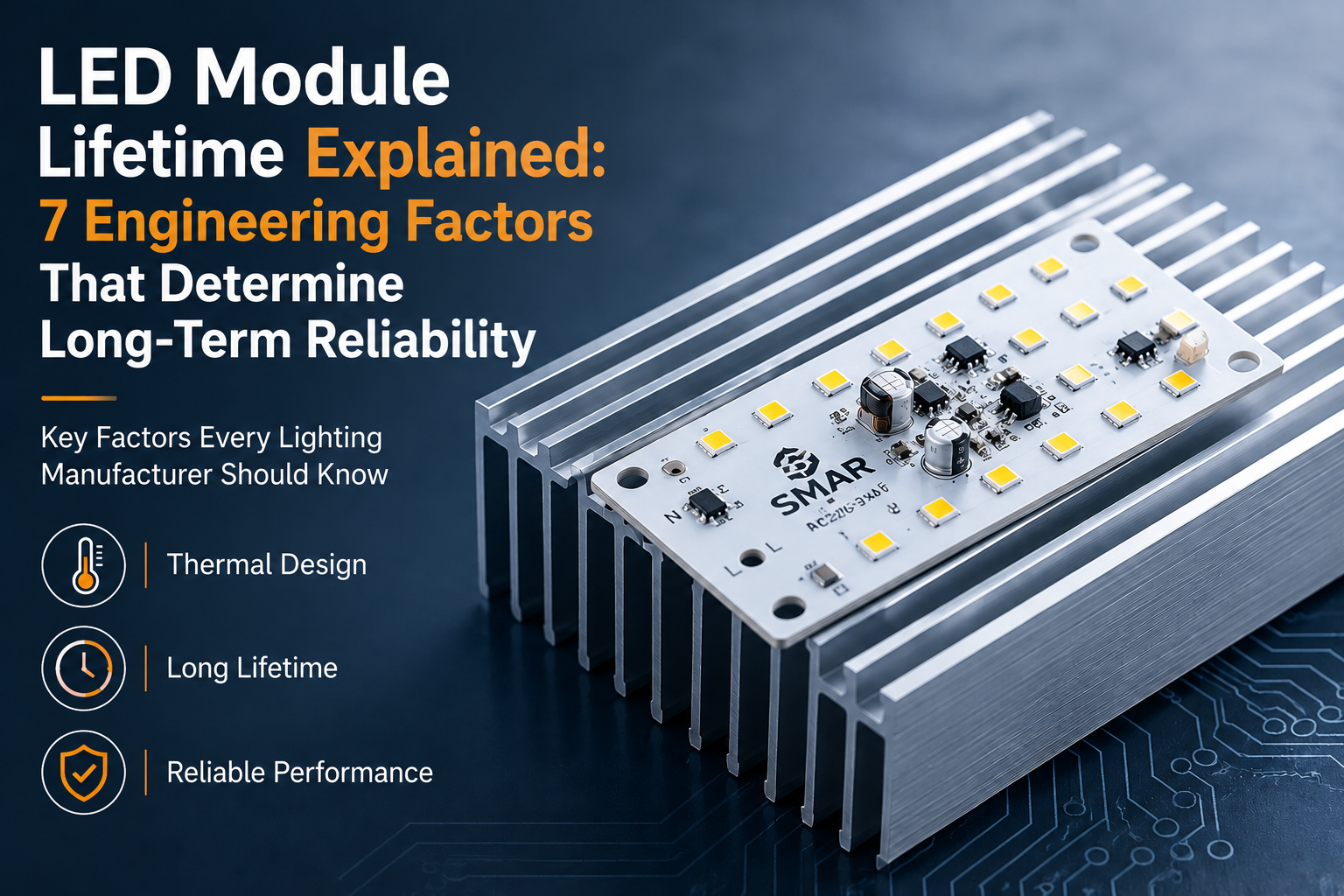
When selecting LED modules — whether a DOB module, a COB module, or a custom LED PCB — many lighting manufacturers naturally focus on specifications such as luminous efficacy, power factor (PF), color temperature (CCT), and overall cost. While these parameters are essential, they do not tell the whole story. A module that performs well on the first day but loses brightness, develops color shift, or fails prematurely can quickly erase any savings achieved during purchasing.
Today, customers expect lighting products to deliver not only high efficiency but also long-term reliability. Commercial buildings, factories, warehouses, street lighting systems, and public infrastructure often operate for 10 to 24 hours every day. In these environments, maintenance costs, labor expenses, and downtime can easily exceed the original cost of the LED module. As a result, LED module lifetime has become one of the most important indicators of product quality and a key consideration for lighting manufacturers, OEM suppliers, and project contractors.
Extending the lifetime of an LED module is not simply a matter of selecting premium LED chips. Long-term performance depends on multiple engineering factors working together, including thermal management, driver stability, PCB materials, component quality, surge protection, manufacturing consistency, and luminaire design. Optimizing only one aspect while ignoring the others rarely produces a truly reliable product.
This guide explains what determines LED module lifetime, why reliability matters in different lighting applications, and how manufacturers can improve long-term performance through better engineering and smarter design decisions. Whether you are developing a DOB module, a custom LED PCB, or a complete lighting fixture, these practical recommendations can help reduce warranty costs, improve customer satisfaction, and strengthen your competitive advantage.
Why LED Module Lifetime Matters
For professional lighting manufacturers, lifetime is far more than a technical specification on a datasheet. It directly influences product reliability, maintenance costs, customer satisfaction, and brand reputation.
Imagine a warehouse equipped with hundreds of high-bay luminaires installed more than ten meters above the ground. If a module fails several years earlier than expected, replacing it requires specialized lifting equipment, maintenance personnel, and production downtime. In many cases, the cost of replacing a failed luminaire is several times higher than the cost of the module itself.
The same principle applies to commercial offices, hospitals, supermarkets, tunnels, and municipal street lighting. Every unexpected failure increases maintenance costs and disrupts normal operations. This is why more project owners are evaluating total cost of ownership (TCO) instead of comparing purchase prices alone.
Long-lasting LED modules provide several important advantages:
Lower maintenance and replacement costs
Reduced warranty claims
Better lumen maintenance over time
Higher customer satisfaction
Stronger brand reputation
Lower total cost of ownership throughout the product lifecycle
From our engineering experience, customers are becoming increasingly concerned with long-term reliability rather than simply comparing initial efficiency figures. A lighting product that operates reliably for 50,000 hours delivers significantly greater value than one that requires frequent maintenance after only a few years of operation.
Ultimately, extending LED module lifetime is not only an engineering objective—it is also a business strategy that helps manufacturers build stronger customer relationships and compete more effectively in global markets.
How Long Should an LED Module Last?
One of the most common questions asked by lighting manufacturers is, "How long should an LED module actually last?" The answer depends on operating conditions, thermal management, and overall system design. However, for professional lighting applications, a well-designed LED module is generally expected to provide 50,000 to 100,000 hours of reliable service.
It is important to understand that LED lifetime does not usually refer to complete failure. Instead, the lighting industry evaluates how gradually the light output decreases over time—a process known as lumen depreciation.
Several internationally recognized metrics are commonly used to describe lifetime performance:
L70 Lifetime
L70 indicates the point at which an LED module still maintains 70% of its original lumen output. This is currently the most widely accepted lifetime standard for commercial and industrial lighting.
L80 Lifetime
Premium commercial and architectural lighting projects often require L80 performance, meaning the module continues to produce 80% of its initial brightness after long-term operation.
L90 Lifetime
For applications requiring exceptionally stable illumination—such as museums, hospitals, laboratories, and precision manufacturing—some customers specify L90 performance, where the module retains 90% of its original light output.
Professional manufacturers estimate these values using internationally recognized testing methods, including LM-80 for LED package testing and TM-21 for lifetime projection. These standards provide far more reliable predictions than marketing claims alone and allow engineers to compare different LED solutions using consistent evaluation criteria.
However, even the highest-quality LEDs cannot achieve their rated lifetime if they operate under excessive temperatures or unstable electrical conditions. Lifetime should therefore be evaluated as a complete system, including the LED chips, driver, PCB, thermal design, and luminaire structure.
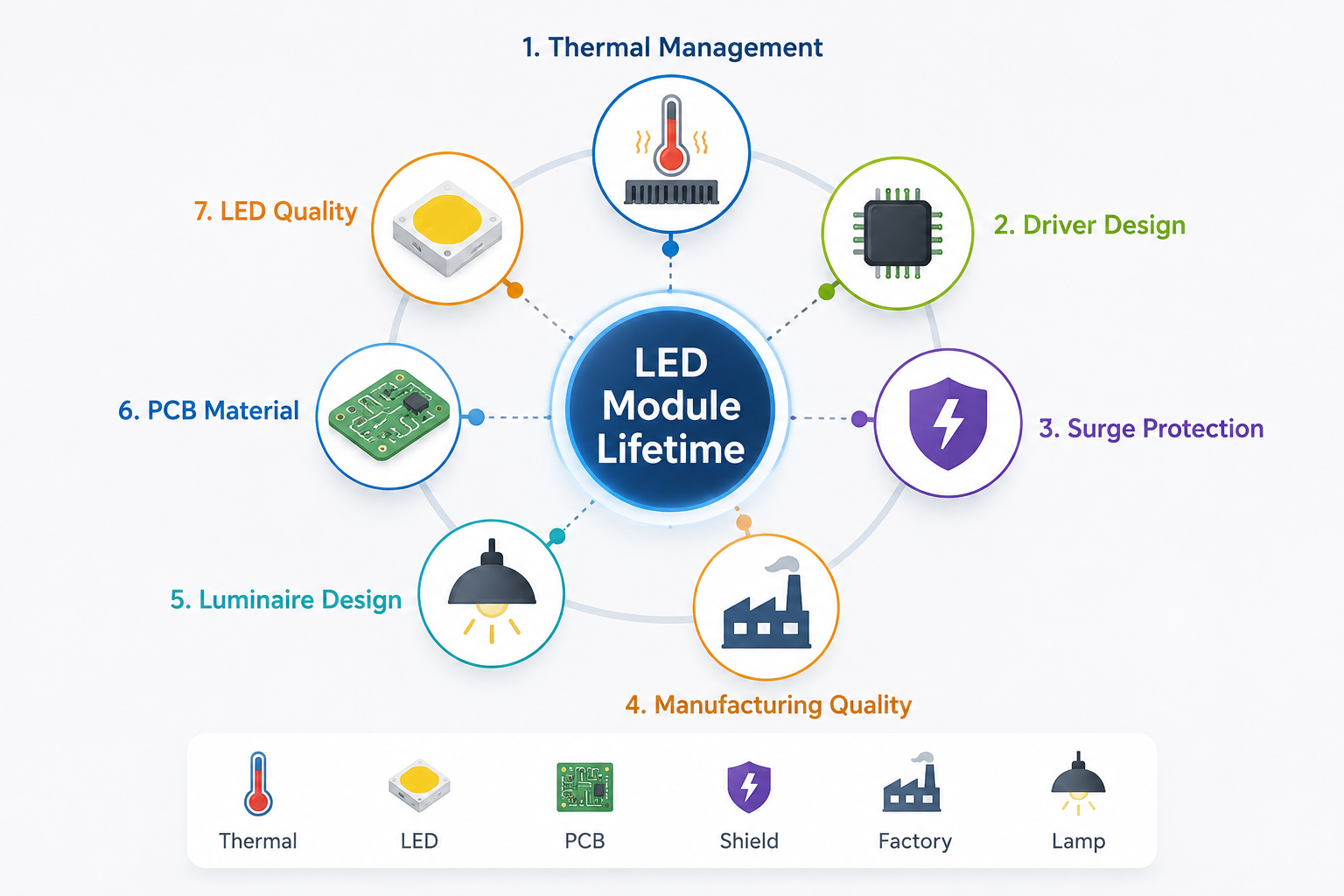
The 7 Key Factors That Determine LED Module Lifetime
1. Thermal Management Is the Foundation of Long-Term Reliability
Among all engineering factors, thermal management has the greatest impact on LED module lifetime.
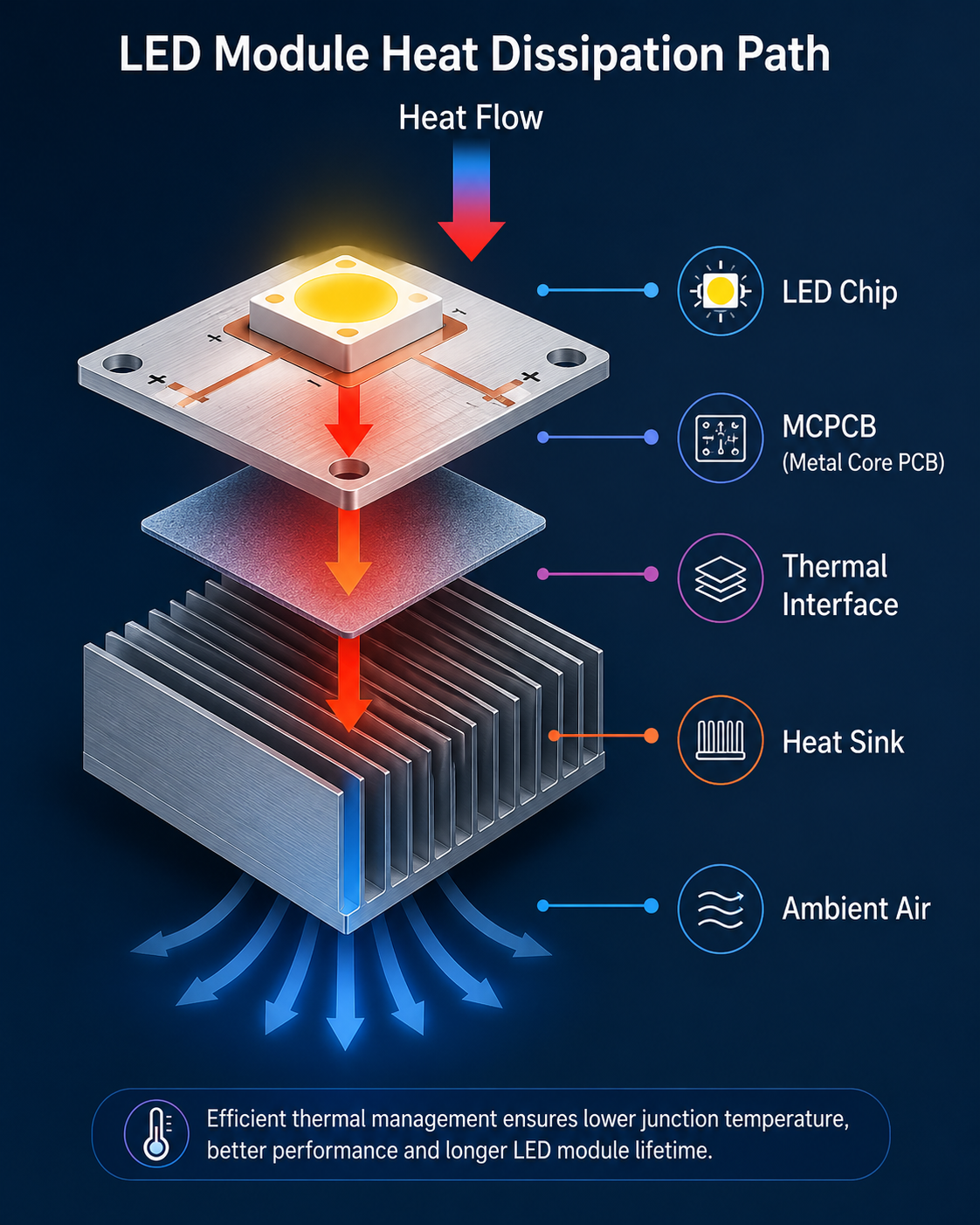
Although LEDs are highly efficient, a significant portion of electrical energy is still converted into heat. If this heat cannot be transferred away efficiently, the junction temperature rises rapidly, accelerating lumen depreciation, color shift, driver aging, and component failure.
A well-designed LED module creates an effective thermal path that moves heat from the LED chips through the MCPCB (Metal Core PCB), into the heat sink, and finally into the surrounding air. Every part of this pathway contributes to long-term reliability.
Professional manufacturers typically optimize:
LED spacing and layout
PCB thermal conductivity
Copper thickness
Heat sink contact area
Airflow inside the luminaire
Even reducing the operating temperature by a few degrees can significantly increase product lifetime. This is why thermal simulation, infrared imaging, and temperature-rise testing have become standard procedures during LED module development.
Simply using premium LEDs cannot compensate for poor thermal design. Effective heat management must be considered from the earliest stage of product development.
2. High-Quality LED Chips Improve Long-Term Stability
LED chips may look similar during initial testing, but their long-term performance can differ dramatically.
Reputable LED manufacturers invest heavily in chip technology, phosphor materials, packaging processes, and production consistency. As a result, their products generally offer better lumen maintenance, smaller color variation, and more predictable long-term reliability.
High-quality LED chips typically provide:
Better lumen maintenance
Reduced color shift
Higher reliability under continuous operation
Verified LM-80 test data
More consistent electrical performance
Although lower-cost LEDs may reduce initial purchasing costs, they often increase the risk of premature lumen depreciation and warranty claims. For commercial, industrial, and municipal lighting projects, investing in reliable LED brands is usually the more economical choice over the product's entire lifecycle.
3. Driver Design Protects Both LEDs and Electronic Components
The driver is often described as the heart of an LED lighting system because it controls how electrical power is delivered to the LEDs.
An unstable driver can expose LEDs to excessive current ripple, voltage fluctuations, and repeated electrical stress. Over time, these conditions accelerate component aging, increase operating temperature, and reduce overall reliability.
Whether using a traditional constant-current driver or a modern DOB (Driver on Board) solution, engineers should focus on:
Stable constant-current output
Low ripple current
High power factor (PF)
Effective surge protection
Good EMC performance
Over-temperature and over-current protection
A properly designed driver not only improves efficiency but also helps maintain consistent light output throughout the product's service life.
This applies equally to COB modules, where the LED chips are mounted as a single integrated array directly on the board. Because COB designs concentrate more LED chips in a smaller area, driver stability and current regulation become even more critical — any ripple or instability in the driver circuit affects the entire array simultaneously, making thermal and electrical consistency across the whole COB module essential for long-term performance.
4. PCB Materials Are More Important Than Many Designers Realize
The PCB is far more than a mechanical support for LEDs and electronic components. It is also one of the most important thermal pathways within the lighting system.
Selecting the right LED PCB directly affects heat dissipation, electrical stability, and long-term reliability.
For most commercial lighting applications, aluminum MCPCBs provide significantly better thermal performance than conventional FR-4 boards because they transfer heat more efficiently away from the LED chips.
When selecting PCB materials, manufacturers should evaluate:
Thermal conductivity
Board thickness
Copper thickness
Dielectric quality
Manufacturing precision
Resistance to thermal cycling
In high-power applications such as street lights, flood lights, and high-bay luminaires, investing in high-quality PCB materials often results in lower operating temperatures, improved lumen maintenance, and a significantly longer service life.
Rather than viewing the PCB as a simple mounting board, experienced engineers treat it as a critical component of the overall thermal management system.
5. Surge Protection Prevents Hidden Damage
While thermal management and driver design often receive the most attention, surge protection is another critical factor that directly affects LED module lifetime.
Power grids are rarely perfectly stable. Lightning strikes, switching operations, motor startups, and other electrical equipment can generate transient voltage surges. Although these surges may last only a fraction of a second, they can gradually weaken sensitive electronic components inside an LED module.
Unlike catastrophic failures, surge damage is often cumulative. A module may continue operating after several small surges, but repeated electrical stress accelerates the aging of driver ICs, capacitors, rectifier bridges, and protection circuits. Eventually, the module may begin to flicker, lose efficiency, or fail completely.
This is particularly important for outdoor applications such as street lighting, flood lights, parking lot luminaires, and landscape lighting, where long cable runs and exposure to lightning increase the likelihood of electrical surges.
A reliable LED module should include multiple protection mechanisms, such as:
Over-voltage protection (OVP)
Over-current protection (OCP)
Metal Oxide Varistors (MOV)
TVS protection devices
Proper grounding and PCB layout
Although surge protection adds only a small cost during manufacturing, it can significantly improve long-term reliability and reduce field failures over the product's lifetime.
6. Manufacturing Quality Determines Product Consistency
Even the most advanced circuit design cannot achieve excellent reliability without consistent manufacturing quality.
Many premature failures originate not from engineering design but from production defects such as poor solder joints, incorrect reflow temperatures, contamination, or inconsistent component placement. These problems may not appear during short functional tests, yet they can gradually reduce product reliability after installation.
Professional LED module manufacturers therefore apply strict quality control throughout the production process.
Typical procedures include:
Incoming material inspection (IQC)
Automated Optical Inspection (AOI)
Controlled SMT reflow soldering
Functional electrical testing
Aging tests
Final quality inspection (FQC)
Among these procedures, aging tests are particularly valuable because they identify early component failures before products leave the factory. This significantly reduces warranty claims and improves batch consistency.
For OEM customers purchasing thousands of modules every month, manufacturing consistency is just as important as engineering capability. Every production batch should deliver the same electrical performance, color consistency, and long-term reliability.
7. A Well-Designed Luminaire Extends LED Module Lifetime
An LED module never operates alone. It functions as part of a complete lighting system, and the design of the luminaire has a direct impact on its operating temperature and service life.
For example, the same LED module may perform very differently when installed in two different fixtures. A luminaire with a large aluminum heat sink and good airflow can maintain a low junction temperature, while a compact enclosed housing may trap heat and significantly reduce lifetime.
Several fixture-related factors influence reliability:
Heat sink size
Airflow inside the housing
Housing material
Ambient operating temperature
Installation orientation
Dust accumulation
IP protection level
Successful lighting manufacturers design the LED module and luminaire together rather than treating them as separate products. This system-level approach helps maximize LED module reliability, improve lumen maintenance, and extend service life under real operating conditions.
The factors above apply across LED module types — DOB modules, COB modules, and traditional driver-based designs all depend on the same underlying principles of thermal management, component quality, and system-level design. The relative priority of each factor, however, shifts depending on the specific application.
Real-World Application Scenarios
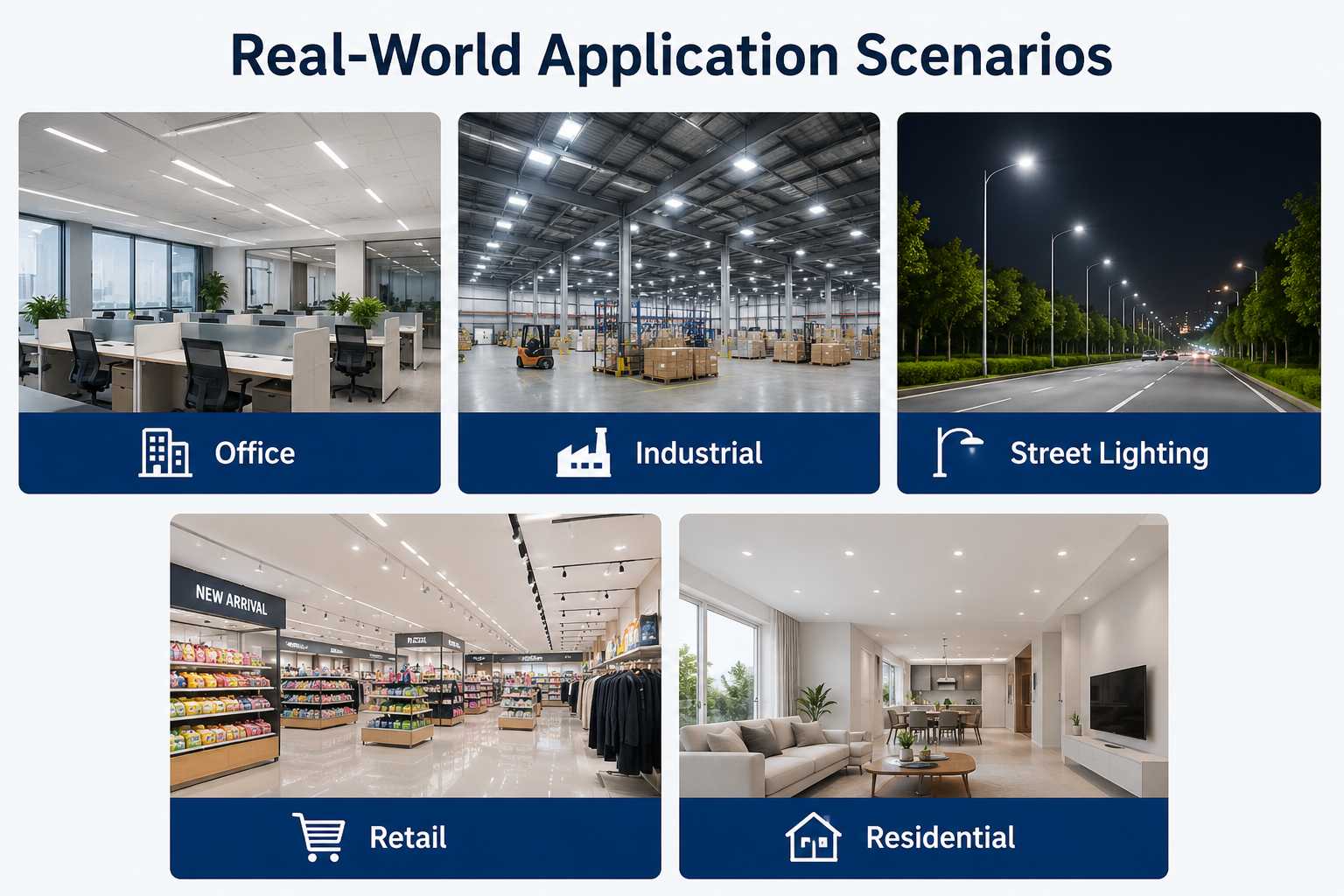
Different applications place different demands on LED module lifetime. Selecting the right design strategy for each environment helps maximize long-term performance and reduce maintenance costs.
Commercial Office Lighting
Office luminaires typically operate 10–12 hours every day, making long-term stability more important than achieving the highest possible luminous efficacy.
Low operating temperatures, stable drivers, and low-flicker performance help create comfortable working environments while reducing maintenance interruptions.
Recommended priorities:
L70 ≥ 50,000 hours
Low flicker
High PF
Stable thermal management
Industrial and Warehouse Lighting
Industrial facilities often operate continuously, exposing lighting products to high ambient temperatures, dust, and vibration.
Because luminaires are usually installed at considerable heights, replacement costs are much higher than the price of the LED module itself.
Recommended priorities:
High-quality aluminum MCPCB
Excellent thermal management
High-temperature capacitors
Reliable surge protection
Street and Outdoor Lighting
Street lights must operate reliably in rain, heat, cold, humidity, and unstable electrical environments.
Long service life is essential because replacing outdoor luminaires requires labor, traffic control, and maintenance equipment.
Recommended priorities:
High-efficiency heat dissipation
≥6kV surge protection
Corrosion-resistant materials
Stable DOB or driver design
Retail and Commercial Display Lighting
Retail lighting directly affects product presentation and customer experience.
Stable lumen output, excellent color consistency, and reliable long-term performance help maintain attractive product displays while minimizing maintenance disruptions.
Recommended priorities:
High CRI LEDs
Low lumen depreciation
Stable color consistency
Reliable thermal design
Residential Lighting
Residential fixtures usually operate fewer hours each day, but homeowners increasingly expect products to remain maintenance-free for many years.
Compact fixture designs require efficient thermal management despite limited installation space.
Recommended priorities:
Compact PCB layout
Efficient heat dissipation
Stable DOB driver
Quiet operation
Common Mistakes That Shorten LED Module Lifetime
Many lifetime problems are caused not by advanced engineering challenges but by avoidable design decisions.
Some of the most common mistakes include:
Choosing Components Based Only on Price
Low-cost LEDs, capacitors, or driver ICs may reduce manufacturing costs initially but often increase failure rates and warranty expenses over the product lifecycle.
Ignoring Thermal Design
Thermal management should be considered during the earliest stages of product development rather than after the electrical design has been completed.
Overdriving LED Chips
Driving LEDs above their recommended current may increase initial brightness but also raises junction temperature and accelerates lumen depreciation.
Selecting the Wrong PCB Material
Standard FR-4 boards may be suitable for low-power products but often struggle to dissipate heat efficiently in commercial and industrial applications.
Neglecting Surge Protection
Without adequate surge protection, repeated electrical stress gradually damages driver components and shortens overall product lifetime.
Skipping Reliability Testing
Insufficient aging tests, thermal validation, or electrical verification can allow hidden defects to reach customers.
Comprehensive testing before mass production is always less expensive than solving reliability issues after installation.
How to Evaluate LED Module Lifetime Before Mass Production
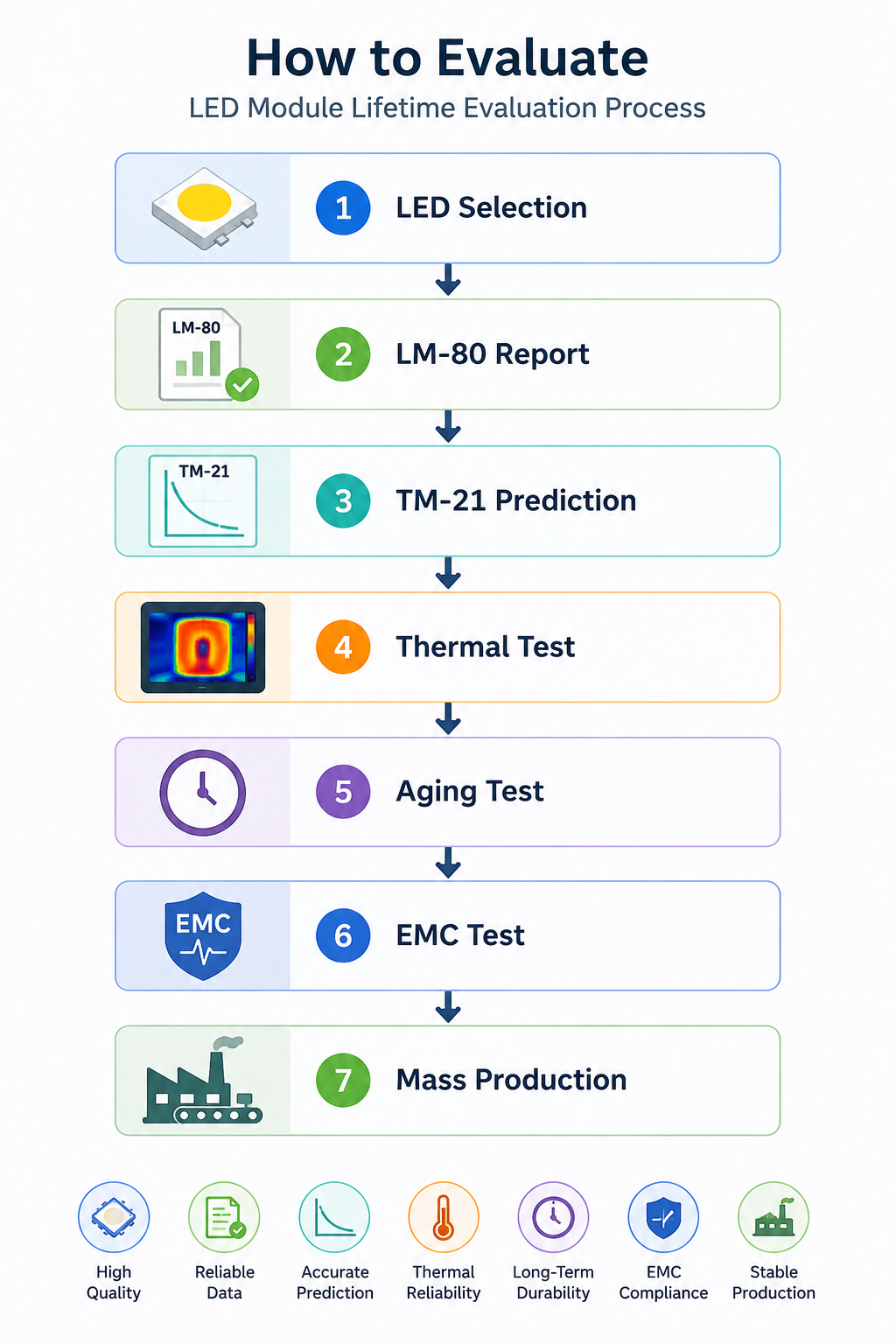
Because an LED module cannot be tested for 50,000 hours before launch, manufacturers rely on internationally recognized testing methods and engineering validation to predict long-term reliability.
A comprehensive evaluation should include:
LM-80 and TM-21 Verification
Confirm that LED packages have verified lumen maintenance data and reliable lifetime projections.
Thermal Testing
Measure junction temperature and identify hot spots using infrared thermal imaging under real operating conditions.
Aging Tests
Operate modules continuously to eliminate early component failures before shipment.
Electrical Performance Testing
Verify constant-current stability, flicker performance, power factor (PF), EMC compliance, and surge protection capability.
Evaluating these factors before mass production significantly reduces warranty risks and improves overall product reliability.
FAQ:
Q1: How long should a professional LED module last?
A:Most commercial LED modules are designed to achieve 50,000–100,000 hours, depending on operating conditions and thermal management.
Q2: What has the greatest impact on LED module lifetime?
A:Thermal management is generally considered the single most important factor. Lower junction temperatures significantly improve lumen maintenance and long-term reliability.
Q3: Does a DOB module have a shorter lifetime than a traditional driver?
A:No. Modern DOB modules can achieve reliability comparable to external drivers when designed with high-quality components, optimized PCB layouts, and effective thermal management.
Q4: Can PCB material influence lifetime?
A:Yes. High-quality aluminum MCPCBs dissipate heat much more efficiently than conventional PCB materials, helping extend product lifetime in high-power applications.
Q5: How can I verify a supplier's lifetime claims?
A:Request technical documentation such as LM-80, TM-21, thermal imaging reports, integrating sphere reports, EMC reports, aging test results, and quality control procedures instead of relying only on marketing specifications.
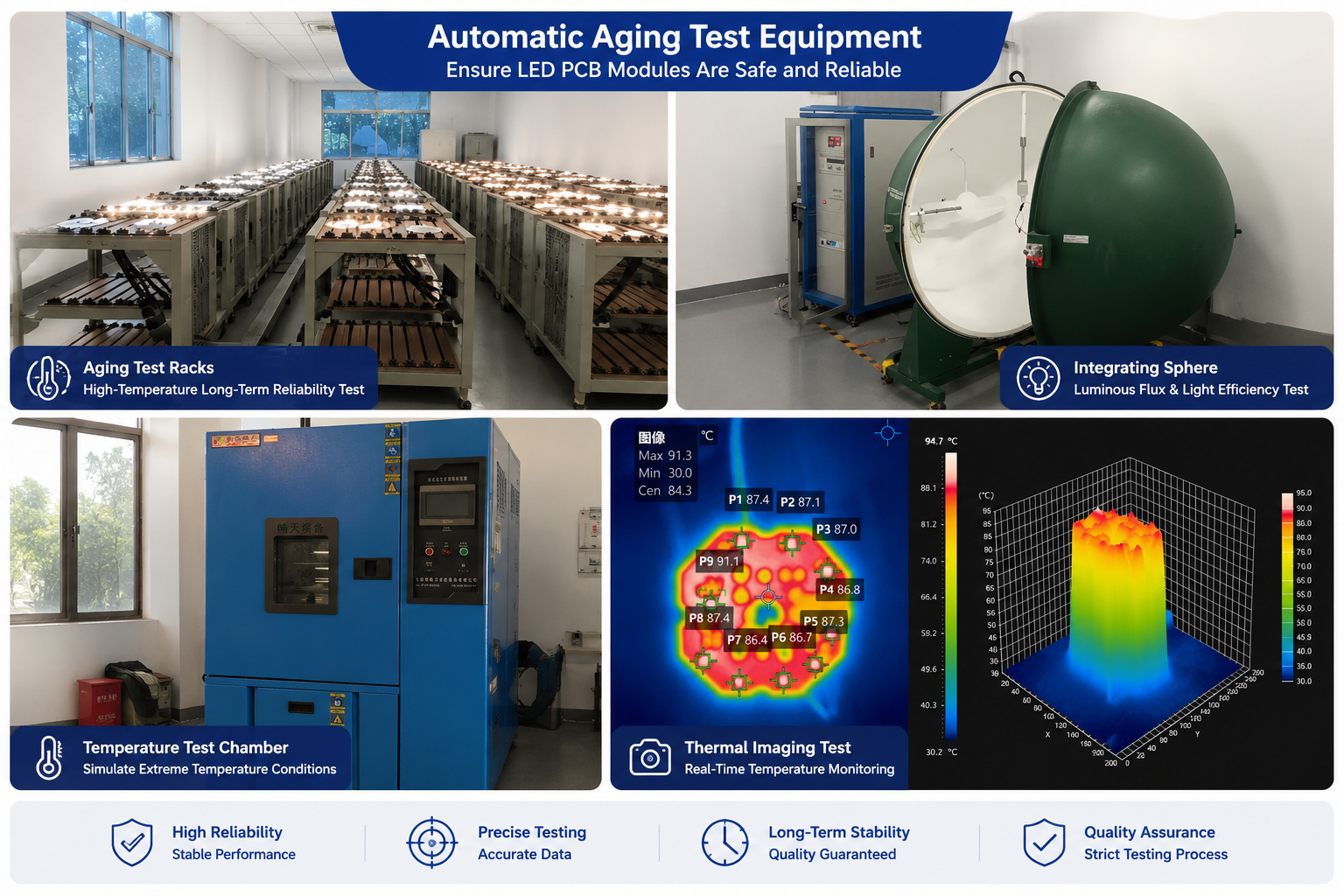
At SMAR LED Lighting, we specialize in custom DOB modules, COB modules, LED PCB solutions, and OEM/ODM lighting products engineered for long service life, excellent thermal management, and stable electrical performance. From prototype development and thermal optimization to automated SMT production and comprehensive testing, we help lighting manufacturers build reliable products that perform consistently throughout their entire service life.
Explore SMAR LED Lighting's Product Range
View Our DOB Module Product Range → DOB Module Manufacturer | AC Direct Driver LED Module Supplier | SMAR
View Our COB Module Product Range → COB LED Module Manufacturer | COB Light Engine Supplier | SMAR
View Our LED PCB Manufacturing Capabilities → LED PCB Manufacturer | Custom Aluminum PCB & MCPCB Supplier | SMAR
Request LM-80 and Reliability Documentation → Contact
Related: How to Choose a Reliable DOB Module Supplier → How to Choose a Reliable DOB Module Supplier: A Complete Guide for Lighting Manufacturers
Related: DOB Module vs Traditional LED Driver → DOB Module vs Traditional LED Driver A Practical Guide for Lighting Manufacturers