
info@smarledlighting.com
+86 20 38466982
Toggle Navigation


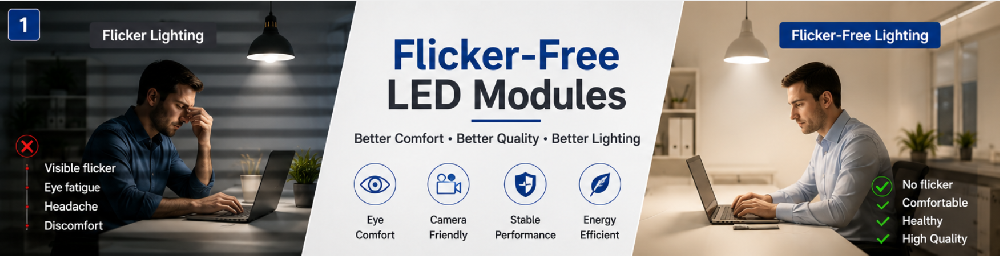
When evaluating LED lighting products, engineers and buyers usually focus on lumen output, energy efficiency, color temperature (CCT), power factor (PF), and overall cost. While these specifications are important, one critical performance factor is often overlooked—LED flicker.
A lighting product may deliver high luminous efficacy and still perform poorly if flicker is not properly controlled. Excessive flicker can reduce visual comfort, interfere with security cameras and video recording systems, create stroboscopic hazards around moving machinery, and even prevent products from meeting international lighting standards such as IEEE 1789, Energy Star, and the EU Ecodesign (ErP) requirements.
As lighting technology continues to evolve, flicker-free performance has become an essential indicator of product quality rather than a premium feature. Whether the application is commercial lighting, industrial facilities, educational environments, healthcare projects, or high-end residential lighting, stable light output plays a vital role in user comfort, safety, and long-term reliability.
In this guide, we explain what LED flicker is, why it occurs, how it is measured, the hidden costs of poor flicker performance, and how to choose a truly flicker-free DOB module for modern lighting applications.
What Is LED Flicker?
LED flicker is the rapid variation of light output over time. Unlike incandescent lamps — which have thermal mass that smooths out current variation — LEDs respond almost instantaneously to changes in drive current. When the current supplied to an LED fluctuates, the light output fluctuates with it.
The primary source of flicker in LED modules is ripple in the drive current. In a DOB (Driver On Board) module, the AC mains supply must be converted to a stable DC current for the LEDs. If the filtering in the driver circuit is insufficient, residual ripple at 100Hz (in 50Hz markets) or 120Hz (in 60Hz markets) — twice the mains frequency — passes through to the LED current. The result is light output that pulses at 100 or 120 times per second.
Additional sources of flicker include switching frequency artifacts from the driver IC, component quality degradation over time, and instability under varying load conditions or input voltage fluctuations.
How Flicker Is Measured
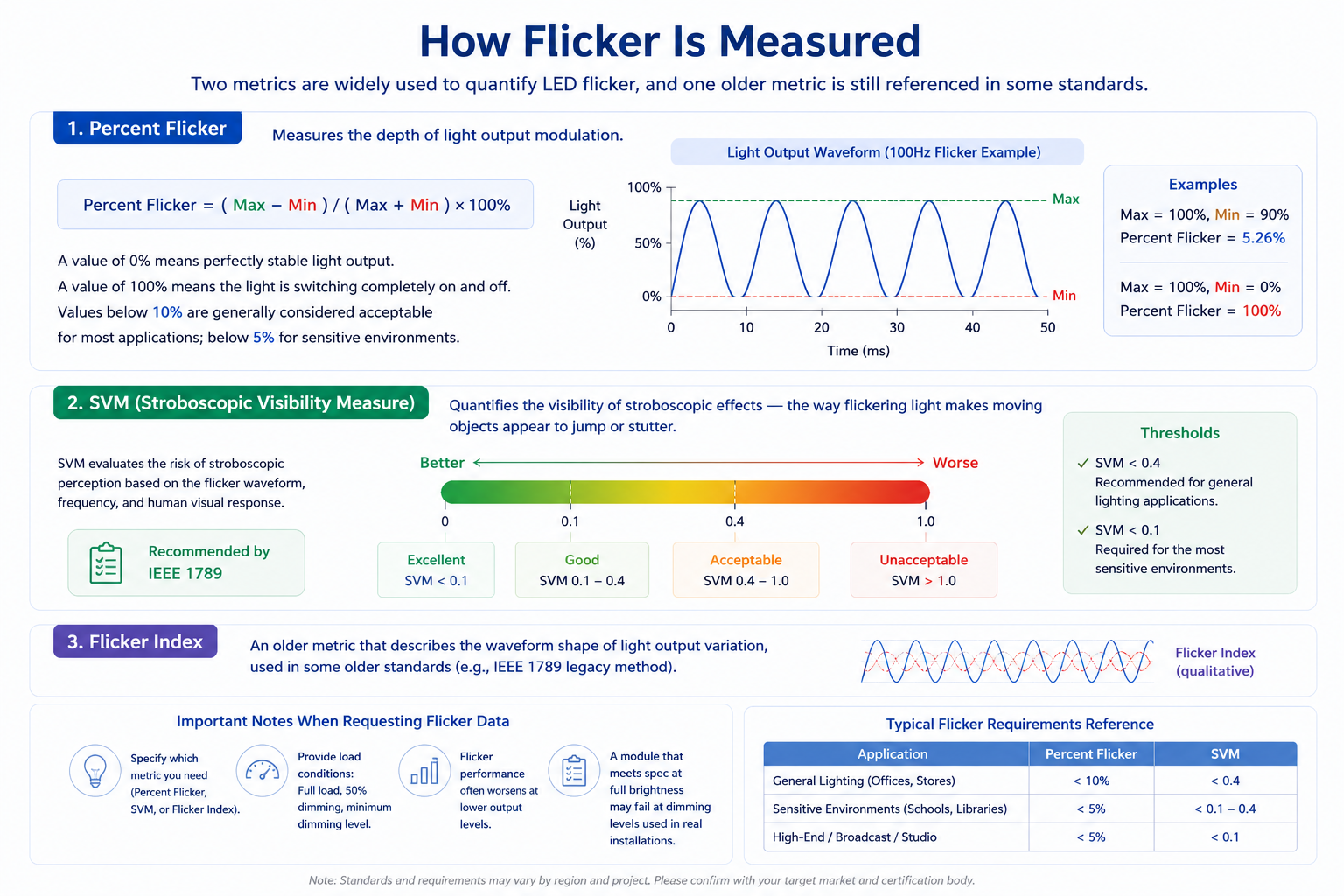
Two metrics are widely used to quantify LED flicker:
Percent Flicker measures the depth of light output modulation:
Percent Flicker = (Max - Min) / (Max + Min) × 100%
A value of 0% means perfectly stable light output. A value of 100% means the light is switching completely on and off. Values below 10% are generally considered acceptable for most applications; below 5% for sensitive environments.
SVM (Stroboscopic Visibility Measure) quantifies the visibility of stroboscopic effects — the way flickering light makes moving objects appear to jump or stutter. SVM < 0.4 is the threshold recommended by IEEE 1789 for general lighting applications. SVM < 0.1 is required for the most sensitive environments.
Flicker Index is an older metric that describes the waveform shape of light output variation, used in some older standards.
When requesting flicker data from a supplier, specify which metric you need and at what load conditions — full load, 50% dimming, and minimum dimming level. Flicker performance often deteriorates significantly at reduced output, and a module that meets specification at full brightness may fail at the dimming levels used in actual installation.
The Science of LED Flicker: Why It Occurs
To understand why flicker happens, we must look at how light-emitting diodes operate. LEDs are fundamentally high-speed semiconductor devices with zero thermal or electrical inertia. Unlike traditional incandescent bulbs, whose thick tungsten filaments take time to cool down and thus naturally smooth out minor electrical ripples, an LED reacts instantaneously to the current passing through it. If the electrical current drops to zero for a millisecond, the LED light output drops to zero instantly.
Therefore, LED flicker happens when the electrical current supplied to the LEDs by the driving circuit is unstable or contains high-frequency ripples. This instability usually stems from three core engineering issues:
Substandard Driver Design: In low-cost AC-direct Driver-on-Board (DOB) modules, the rectified AC mains voltage (which alternates at 50Hz or 60Hz depending on the region) is pushed through simple linear driving loops. Without adequate ripple suppression, this creates a massive 100Hz or 120Hz current fluctuation, leading to heavy flicker.
Low-Quality Electronic Components: Utilizing cheap electrolytic or ceramic capacitors with poor capacitance stability under high temperatures means the circuit cannot effectively smooth out electrical ripples over long runtimes.
Insufficient Circuit Protection: When line voltage fluctuations, harmonics, or electromagnetic interference (EMI) enter the circuit from the main grid, a poorly protected module allows these noises to bleed directly into the LED driving loop, creating erratic fluctuations in brightness.
Although these issues may seem minor individually, together they determine whether an LED module delivers stable, flicker-free illumination throughout its service life. This is why circuit topology, component selection, and driver design are all equally important during product development.
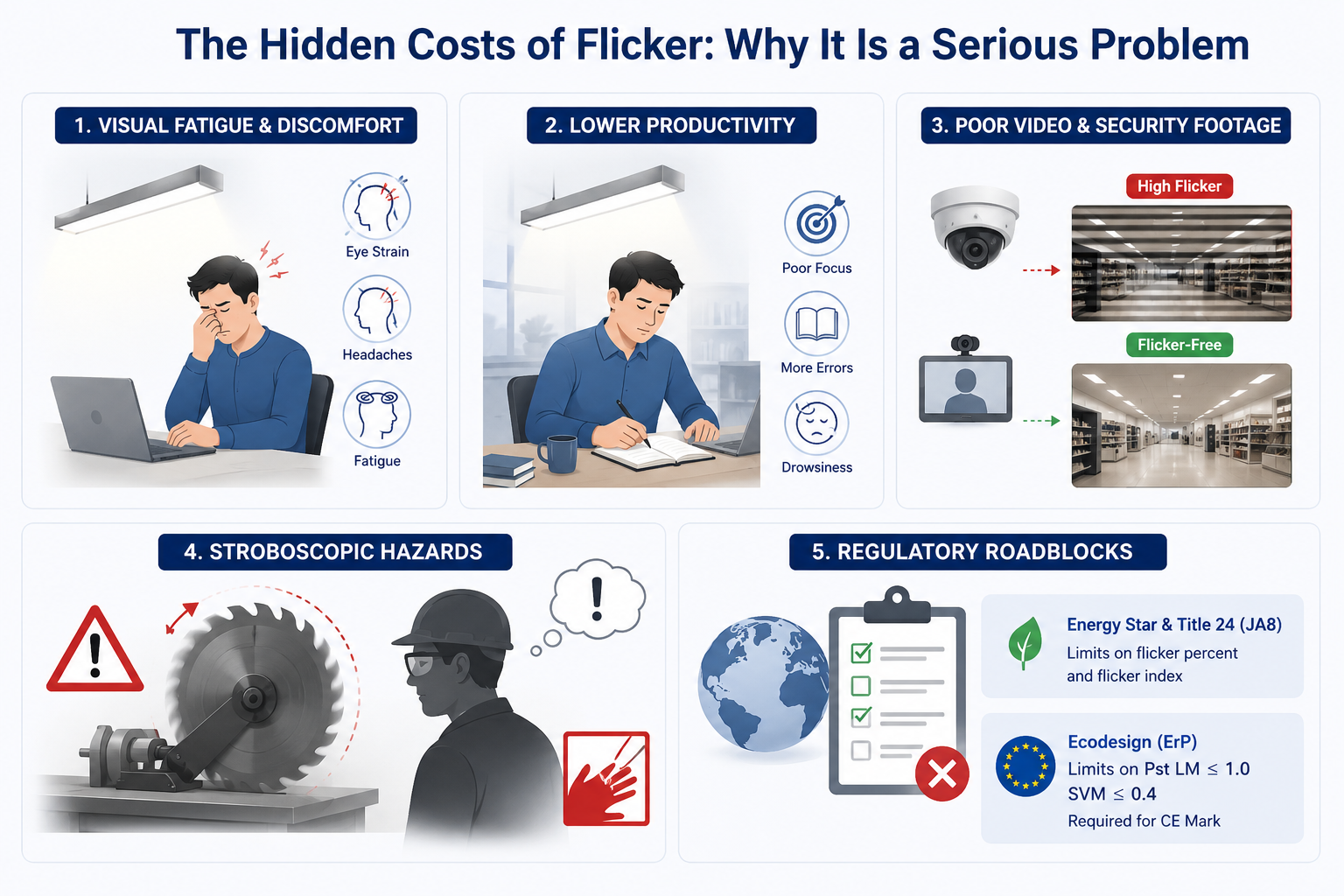
The Hidden Costs of Flicker: Why It Is a Serious Problem
1. Chronic Visual Fatigue and Physical Discomfort
Even when flicker is too fast to be consciously noticed (invisible flicker, typically between 100Hz and several kilohertz), the human retina still detects the high-frequency modulation. The brain works overtime to process this unstable visual input. Prolonged exposure to high-flicker environments leads to:
Asthenopia (severe eye strain and burning sensations).
Unexplained migraines and tension headaches.
Subconscious mental fatigue, dizziness, and a general reduction in well-being.
2. Degraded Working and Learning Productivity
In offices, university lecture halls, public schools, and research laboratories, sustained concentration is paramount. High-flicker environments impair the human eye’s natural saccadic movements (the rapid movements the eye makes while reading text). This makes it harder for students and employees to focus, increases reading errors, and accelerates afternoon drowsiness. Flicker-free LED modules keep illumination perfectly flat, optimizing focus and long-term cognitive endurance.
3. Destruction of Digital Video and Security Footage
We live in an era blanketed by digital sensors—smartphones, security cameras, automated face-recognition systems, and video-conferencing terminals. Standard high-flicker lights interact horribly with the rolling shutters of modern CMOS camera sensors. This interaction creates moving black bars, horizontal banding, and erratic frame-rate strobing across the screen, rendering high-definition security footage completely useless and ruining remote video collaborations.
4. Severe Stroboscopic Hazards in Industrial Zones
In heavy manufacturing workshops or machining facilities with rotating parts (like gears, lathe chucks, or circular saw blades), high-frequency stroboscopic flicker can cause a deadly optical illusion known as the stroboscopic effect. If the light modulation matches the rotational speed of the machine, the spinning blade can appear completely stationary to an operator, leading to catastrophic workplace injuries.
5. Stringent New Global Regulatory Roadblocks
Regulatory bodies worldwide have cracked down on poor light hygiene. Products can no longer slide under the radar with excessive ripple current. Standards include:
Energy Star & Title 24 (JA8) in North America: Enforces strict limits on flicker percent and flicker index.
Ecodesign ErP Directives in Europe: Mandates strict limits on Pst LM (Short-Term Flicker Indicator, $le 1.0$) and SVM (Stroboscopic Visibility Measure, $le 0.4$). If your module does not meet these metrics, it cannot legally carry the CE mark.
Real-World Application Scenarios: Choosing the Right Solution
Different applications require different engineering approaches to achieve a flicker-free environment. Let us look at four critical scenarios.
1. Broadcast Studios, Esports Arenas, and Live-Streaming Rooms
The Challenge: These spaces utilize ultra-high-frame-rate cameras (frequently filming at 120fps, 240fps, or higher for slow-motion replays). Standard commercial lighting creates massive, unwatchable banding effects on television broadcasts.
The Custom DOB Solution: SMAR LED Lighting engineers specialized high-frequency pulse-width modulation (PWM) or continuous linear-regulation DOB modules. By pushing the internal driving or dimming frequency far beyond 50kHz, the light output appears perfectly flat and continuous even to the most advanced cinema cameras.
2. Smart Corporate Offices and Educational Classrooms
The Challenge: Fixtures must be thin, sleek, and highly dimmable via TRIAC or 0-10V controls, all while maintaining absolute visual comfort and quiet operation (no audible humming) over 12-hour workdays.
The Custom DOB Solution: We embed advanced two-stage ripple-filtering circuits directly onto linear and square Driver-On-Board modules. These circuits absorb the grid-induced 100Hz/120Hz ripple completely, maintaining an SVM of less than 0.1 across the entire dimming spectrum, from 100% brightness down to 1%.
3. Automated Logistics Warehouses and Precision Manufacturing Floors
The Challenge: High ceilings require high-power DOB modules (80W to 150W) that generate significant heat, yet the light must be safe from stroboscopic illusions near moving conveyor belts and robotic arms.
The Custom DOB Solution: We utilize high-conductivity Metal Core PCBs (MCPCB) combined with premium industrial-grade driver ICs that feature active power factor correction (PFC) and thermal foldback. The driver maintains flat, flicker-free current delivery without failing under ambient temperatures up to 65°C.
4. Luxury Hospitality and High-End Retail Boutiques
The Challenge: Lighting must make textures pop (High CRI >95) and dim smoothly down to a warm, intimate candle-like glow without introducing sudden jumps, drops, or micro-flashes that disrupt the customer experience.
The Custom DOB Solution: Customized Dim-to-Warm and Tunable White DOB modules are designed with specialized digital control algorithms. These algorithms transition color temperatures smoothly from 4000K down to 2200K while keeping voltage and current deliveries fully stabilized, ensuring a flawless luxury ambiance.
How to Evaluate Flicker Performance When Selecting a DOB Module
Request measured data, not specifications
A datasheet value for "low flicker" or "flicker-free" without supporting measurement data is not a reliable basis for product qualification. Request a test report from a calibrated flicker meter (Admesy, Gigahertz-Optik, or equivalent) showing Percent Flicker and SVM values at full load and at representative dimming levels. The measurement standard should be specified.
Test at actual operating conditions
Flicker performance is load-dependent, temperature-dependent, and input voltage-dependent. A module that meets specification at room temperature and nominal input voltage may perform worse at elevated temperature or at the extremes of its input voltage range. For critical applications, request testing at worst-case conditions or arrange your own verification testing on received samples.
Evaluate driver IC quality
The driver IC is the primary determinant of flicker performance in a DOB module. ICs from established manufacturers with dedicated flicker control features (active PFC, controlled switching frequency, ripple suppression) consistently outperform generic ICs on flicker metrics. A supplier who can name the driver IC they use and explain its flicker control features has genuine engineering knowledge of their product.
Check component quality — especially capacitors
Electrolytic capacitors in the driver circuit smooth the rectified AC waveform and directly affect ripple and flicker. Low-quality capacitors with lower capacitance values, lower voltage ratings, or higher ESR (Equivalent Series Resistance) produce more ripple and more flicker. They also degrade faster at elevated temperature, meaning a module that meets flicker specification when new may develop flicker problems after 6–12 months of operation. Ask for capacitor brand and temperature rating.
Assess dimming compatibility
If the installation requires dimming, specify the dimming protocol (TRIAC, 0-10V, PWM) and request flicker data at multiple dimming levels — particularly at the minimum operating point. PWM dimming at low duty cycles produces severe stroboscopic effects at frequencies the eye cannot consciously detect but that cameras will capture. For camera-sensitive environments, avoid PWM dimming or specify a minimum PWM frequency above 1000Hz.
FAQ
Q1: Does a low-flicker DOB module consume more power than a high-flicker alternative?
A: No. The filtering circuits and advanced driver ICs used to eliminate flicker do not consume significant overhead power. They merely smooth out the flow of electricity, organizing the energy so it reaches the LED chips uniformly. The impact on overall luminous efficacy is negligible, but the upgrade in light quality is massive.
Q2: Is flicker that I cannot see still harmful?
A: Yes. The visual cortex processes light variation at frequencies well above the conscious flicker detection threshold (approximately 50–80Hz for most people). High-frequency flicker that is invisible to the eye has been associated with eye strain and headache in multiple research studies. The SVM metric was specifically developed to quantify stroboscopic effects at frequencies above conscious detection. Do not assume that invisible flicker is harmless.
Q3: Do Driver-on-Board (DOB) modules always have more flicker than external drivers?
A: Historically, early-generation DOB modules suffered from high flicker because they lacked the physical space to mount large filtering components. However, modern semiconductor technology has revolutionized DOB design.
At SMAR LED Lighting, we utilize highly integrated, advanced driver ICs and compact, high-efficiency smoothing electronics built directly onto the aluminum substrate. This allows our custom DOB modules to achieve the same ultra-low flicker and low SVM performance as traditional, bulky external driver boxes while preserving a highly compact form factor.
Q4: Can grid harmonics from other household appliances cause an LED module to flicker?
A: Yes. If an LED module lacks robust line filtering, electromagnetic noise injected into the building's wiring by devices like microwave ovens, air conditioners, or elevators can pass straight through the driver and cause the LEDs to stutter or fluctuate. This is why excellent EMC (Electromagnetic Compatibility) engineering is vital; a well-designed module incorporates filtering chokes and protection varistors to isolate the LEDs from grid pollution.
Q5: How does SMAR LED Lighting guarantee low-flicker performance on custom-shaped modules?
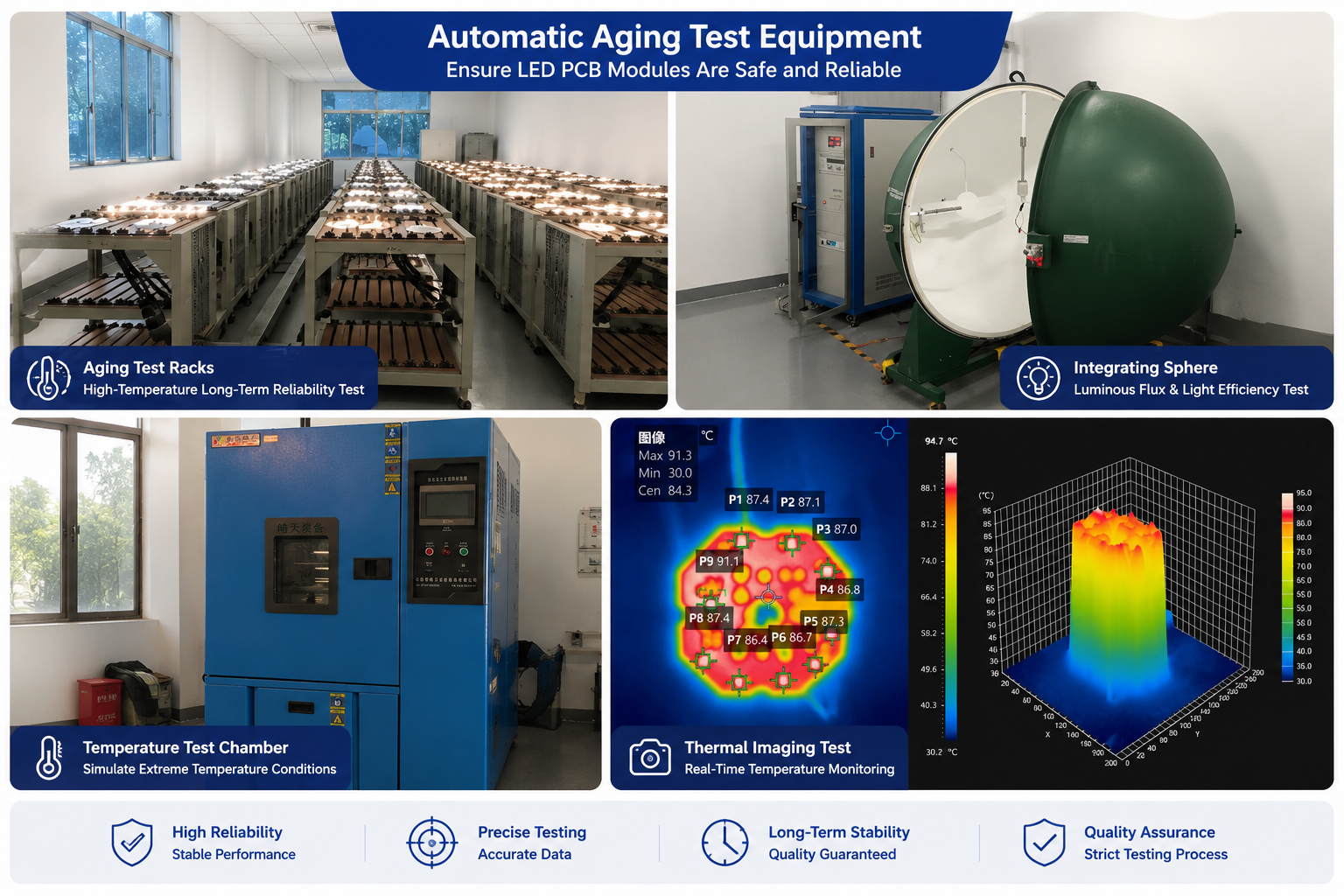
A: Whenever we adjust a board's shape—whether it is an ultra-narrow linear strip, a giant circular ring, or a custom polygon—the electrical impedance changes. Our engineering team conducts thorough PCB layout simulations, optimizes the trace paths to isolate power noise, and validates the physical prototype in our dedicated testing darkroom to ensure compliance with standards before mass production begins.
Conclusion
Whether your project focuses on commercial lighting, industrial luminaires, educational facilities, or camera-sensitive environments, selecting a well-engineered flicker-free LED module is an investment in long-term product quality and customer satisfaction.
If you're developing a custom lighting solution, our engineering team is ready to help optimize your DOB module for low flicker, high efficiency, excellent thermal performance, and reliable EMC compliance.
Explore our custom LED module solutions or contact us to discuss your next project.
Explore SMAR LED Lighting's Flicker-Free Module Solutions
SMAR LED Lighting manufactures DOB modules and LED PCB solutions with documented low-flicker performance for commercial, medical, educational, and hospitality lighting applications worldwide.
View Our DOB Module Product Range → DOB Module Manufacturer | AC Direct Driver LED Module Supplier | SMAR
Request Flicker Test Data for a Specific Module → Contact
Related: Why EMC Matters for LED Modules → Why EMC Matters for LED Modules and How to Choose the Right Solution
Related: Common LED Module Failures and How to Prevent Them → Common LED Module Failures and How to Prevent Them
Related: DOB Module Application Guide → DOB Module Application Guide-Choosing the Right Solution for 5 Key Lighting Scenarios
Related: How to Choose a Reliable DOB Module Supplier → How to Choose a Reliable DOB Module Supplier: A Complete Guide for Lighting Manufacturers