
info@smarledlighting.com
+86 20 38466982
Toggle Navigation


In LED lighting projects, engineers and procurement managers typically focus on brightness, efficacy, cost, and thermal performance. EMC — Electromagnetic Compatibility — is often treated as an afterthought, something to address during certification testing rather than at the design stage.
This approach is expensive. A lighting product that fails EMC certification after tooling, sampling, and initial production has already consumed significant development resources. Redesigning the driver circuit, replacing components, or re-laying the PCB at that stage costs far more than selecting an EMC-compliant module from the beginning.
This guide explains what EMC means in the context of LED modules, why it matters across different application categories, how to evaluate a module's EMC performance before committing to a supplier, and what questions to ask during product qualification.
Understanding EMC in the Context of LED Lighting
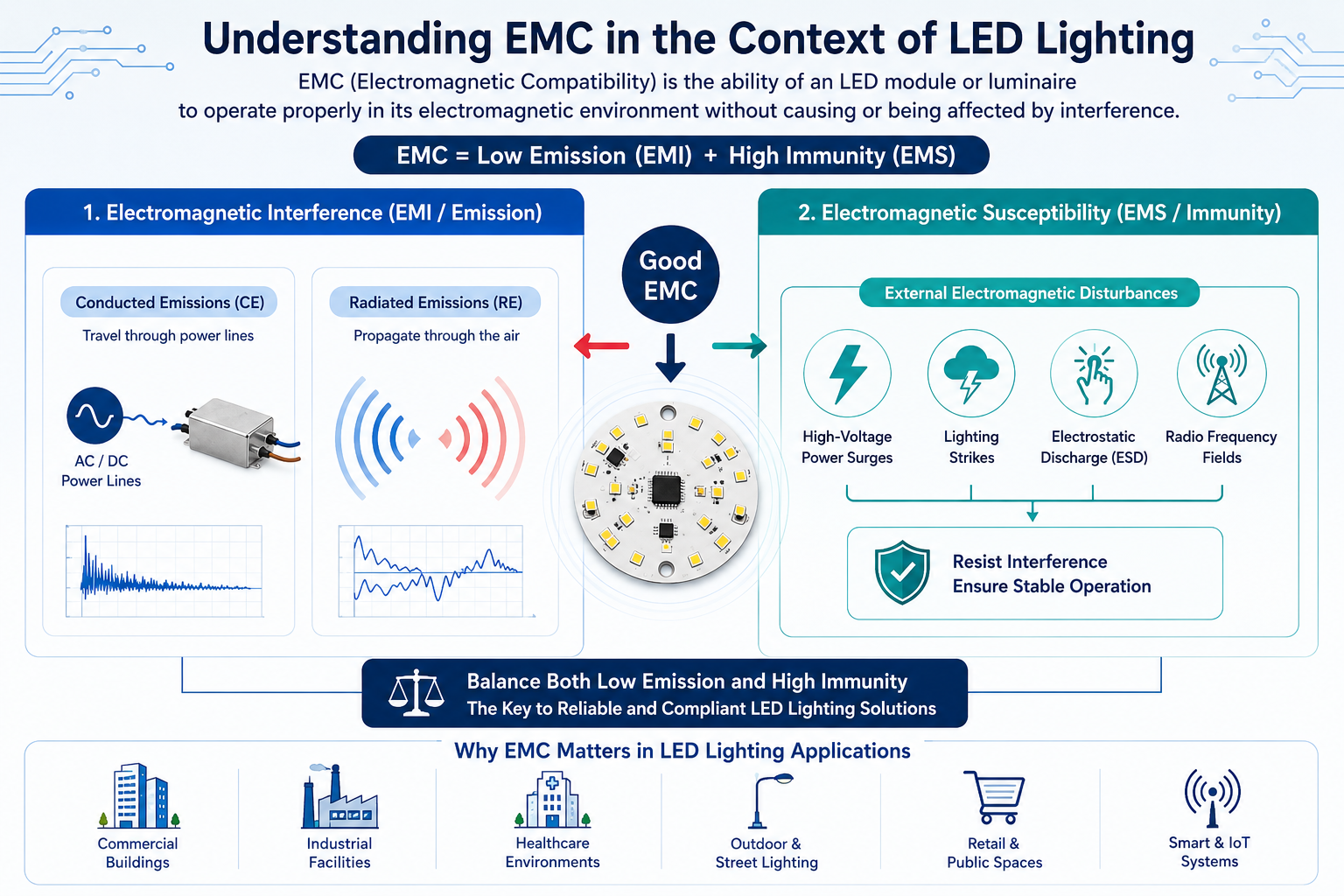
EMC stands for Electromagnetic Compatibility. In the context of LED lighting engineering, it is defined as the ability of an LED module or complete luminaire to operate properly in its intended electromagnetic environment without introducing intolerable electromagnetic disturbances to anything in that environment.
EMC is split into two distinct, yet equally important branches:
1.Electromagnetic Interference (EMI / Emission): This refers to the unwanted electromagnetic energy generated by the LED module’s switching circuits. If unchecked, this energy can escape the fixture and disrupt other devices. It manifests as Conducted Emissions (CE), which travel through the AC/DC power lines, and Radiated Emissions (RE), which propagate through the air as radio waves.
2.Electromagnetic Susceptibility (EMS / Immunity): This represents the LED module's internal resilience. It measures how effectively the circuit resists external electromagnetic disturbances—such as sudden high-voltage power surges, lightning strikes, electrostatic discharge (ESD), or radio frequency fields from nearby transmitters—without flickering, dimming, or failing.
For LED modules, achieving a balance between low emission and high immunity is paramount, particularly in dense commercial, heavy industrial, and critical public utility lighting applications.
EMC Regulations: What Markets Require
Most major markets have mandatory EMC requirements for LED lighting products. Selling a non-compliant product in these markets is illegal and exposes the manufacturer to product recalls, fines, and reputational damage.
Europe: CE marking requires compliance with the EMC Directive (2014/30/EU). The relevant standards for LED lighting modules include EN 55015 (conducted and radiated emissions) and EN 61000-3-2 (harmonic current limits). Products must be tested by an accredited laboratory and documented with a Declaration of Conformity.
North America: FCC Part 15 covers radiated and conducted emissions for electronic devices including LED lighting. UL certification additionally covers safety. Products sold to commercial and industrial customers typically require documented FCC compliance.
Australia and New Zealand: The ACMA (Australian Communications and Media Authority) mandates compliance with AS/NZS CISPR 15 for lighting equipment EMC.
Middle East: SASO certification in Saudi Arabia and ESMA certification in the UAE include EMC components based on IEC standards.
For lighting manufacturers developing products for multiple export markets, choosing a DOB module supplier with documented EMC test experience across these standards significantly reduces certification risk and timeline.
What Problems Can Poor EMC Performance Cause?
When an LED module suffers from deficient EMC design, the consequences ripple across the entire product lifecycle, affecting hardware stability, project timelines, and brand reputation.
1. Unexpected Visual Anomalies and Flickering
Poor EMS (immunity) design means the LED module cannot filter out high-frequency noise or minor voltage fluctuations present on the electrical grid. When heavy machinery or HVAC systems cycle on nearby, the noise bleeds directly into the LED driving loop. This results in sudden visual flickering, micro-stroboscopic effects, or unexpected dimming, which ruins visual comfort.
2. Severe Interference with Nearby Electronic Equipment
High switching frequencies within poorly filtered DOB drivers turn the PCB traces into unintended antennas, radiating electromagnetic noise. This noise can cripple nearby sensitive electronics. Common field failures include:
Disrupting Wi-Fi, Bluetooth, and cellular signals in smart office buildings.
Creating severe static on AM/FM radio frequencies or wireless intercoms.
Interfering with medical monitoring equipment in hospitals or scanning systems in retail environments.
3. Disastrous Regulatory and Certification Failures
Before any electronic lighting product can legally enter a global market, it must comply with strict statutory standards. If your LED module fails EMC testing, it cannot receive critical regulatory markings such as CE (Europe), FCC (North America), VCCI (Japan), or CCC (China). Failing these tests late in the product development cycle results in expensive redesigns, laboratory re-testing fees, and massive shipping delays.
4. Degraded Product Stability and Shortened Lifespan
EMC issues are fundamentally energy management failures. Unfiltered high-frequency spikes and transient voltage surges put continuous electrical stress on delicate semiconductor components—such as the driver IC, rectifiers, and the LED junctions themselves. Over time, this cumulative stress induces micro-damage, leading to premature component degradation, sudden driver failure, or accelerated lumen depreciation.
“Fixing an EMC issue after a product has been manufactured is up to 10 times more expensive than designing a compliant circuit from the very beginning. It is the difference between changing a few components on a schematic versus re-engineering a completed plastic housing or aluminum casting.”
Real-World Application Scenarios: The Cost of Ignoring EMC
To see how EMC impacts project viability, let us examine four real-world scenarios where sub-standard electromagnetic design can lead to critical operational failures.
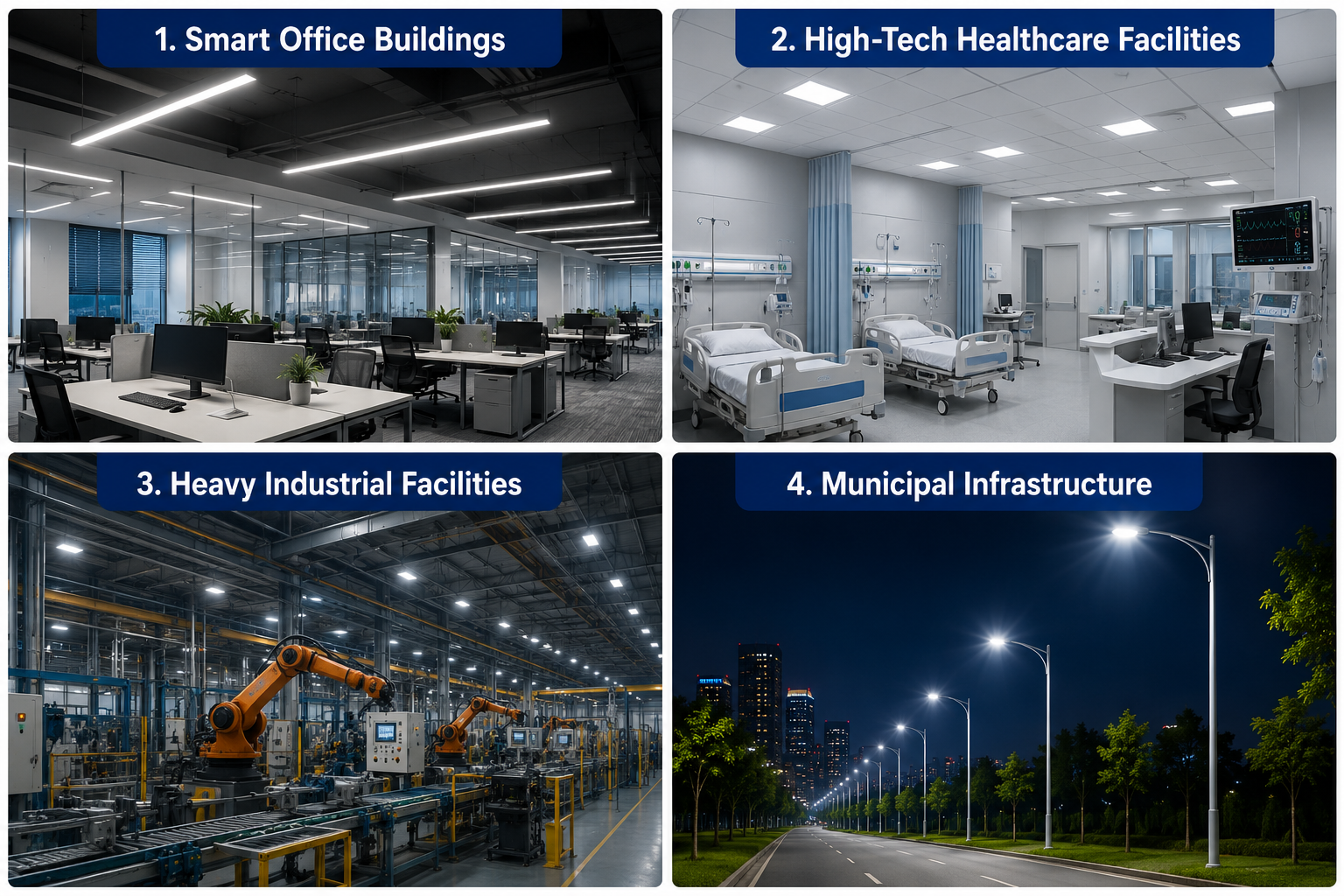
1. Smart Office Buildings and Corporate Workspace Lighting
Modern corporate offices are packed with communication infrastructure—wireless access points, PoE networks, IoT occupancy sensors, and wireless video conferencing systems.
The EMC Threat: If an office utilizes linear pendant fixtures driven by low-cost, unshielded DOB modules that emit high Radiated Emissions (RE), the cumulative noise from hundreds of lamps can significantly degrade the local Wi-Fi bandwidth and disrupt Bluetooth-based office tracking systems.
The Solution: Implementing an EMC-optimized linear LED module utilizing specialized layout routing, localized ground planes, and embedded differential-mode filters ensures zero radio-frequency bleed, preserving the building’s wireless integrity.
2. High-Tech Healthcare Facilities and Hospital Wards
Hospitals rely heavily on low-amplitude, hyper-sensitive electronic diagnostics, including Electrocardiogram (ECG) machines, patient telemetry monitors, and wireless nurse call buttons.
The EMC Threat: An LED module with poor Conducted Emissions (CE) introduces harmonic noise backward into the hospital room's shared AC electrical lines. This harmonic distortion can corrupt the sensitive readings of diagnostic monitors, leading to false alarms or inaccurate patient data tracking.
The Solution: Specifying high-compliance LED modules that integrate active filtering circuits to keep Total Harmonic Distortion (THD) below 10% and pass strict medical-adjacent EMI criteria.
3. Heavy Industrial Facilities and Automation Workshops
Industrial automation floors run heavy inductive loads, such as multi-kilowatt electric motors, CNC mills, and robotic arc welders. These machines inject massive electrical noise and extreme transient voltage surges into the factory grid.
The EMC Threat: In this environment, the primary threat is to the LED module’s immunity (EMS). A generic LED module lacks robust line protection; high-voltage surges from a nearby welder turning on will bypass the basic driver circuit, causing immediate component blowout or intermittent flashing across the entire actory bay.
The Solution: Utilizing heavy-duty industrial DOB modules fortified with an onboard multi-stage protection matrix, including gas discharge tubes (GDTs), heavy-duty metal oxide varistors (MOVs), and transient voltage suppression (TVS) diodes capable of absorbing surges up to 4KV or 6KV.
4. Municipal Infrastructure and Outdoor Street Lighting
Streetlights and parking lot luminaires are exposed to unpredictable outdoor grids, lightning strikes, and electrostatic variations due to weather fronts.
The EMC Threat: Street lighting networks operate in series over long physical distances. A single streetlight module generating massive line harmonics can degrade the performance of an entire municipal grid segment, drawing penalties from utility companies and failing local efficiency benchmarks.
The Solution: Choosing outdoor DOB modules designed with robust active Power Factor Correction (PFC > 0.95) and highly optimized filtering that keeps harmonic feedback well within statutory utility mandates.
How to Identify and Select a High-EMC LED Module
When vetting an LED component supplier or selecting a DOB module for your next luminaire line, look beyond the basic datasheet specifications. Evaluate their engineering credentials based on these four pillars of EMC excellence:
1. Advanced Structural and Circuit Design
A premium EMC module is evident in its PCB trace architecture. Look for designs that feature:
Short, localized high-frequency current loops to minimize the "loop antenna" effect.
Dedicated ground planes that shield sensitive control logic from high-voltage switching lines.
Strategic physical separation between input AC lines and low-voltage output DC lines to prevent cross-coupling of electrical noise.
2. Premium, Certified Components
EMC performance is entirely dependent on component quality. Low-cost suppliers often cut corners by stripping out filtering elements or using unrated capacitors. High-EMC modules explicitly incorporate:
X and Y Safety Capacitors: Specifically rated to suppress electromagnetic interference across line-to-line and line-to-ground connections.
Toroidal Toroid Common-Mode Chokes: High-permeability inductors designed to block common-mode high-frequency noise while letting desired power currents pass freely.
High-Temperature Ceramic Capacitors: Elements that resist structural aging and maintain stable capacitance under continuous thermal loads.
3. Integrated Multi-Tier Protection Functions
A high-quality module features autonomous protection networks integrated directly onto the substrate:
Surge Clamping Circuits: Instantaneous absorption of transient line surges.
Over-Voltage & Over-Current Safeguards: Circuits that automatically isolate or damp incoming electrical spikes before they reach the delicate LED chips.
Intelligent Thermal Foldback: Driver ICs that continuously monitor board temperature, gently reducing current if thresholds are breached, preventing thermal runaway while maintaining operational EMI stability.
4. Verified Testing Infrastructure and Supplier Expertise
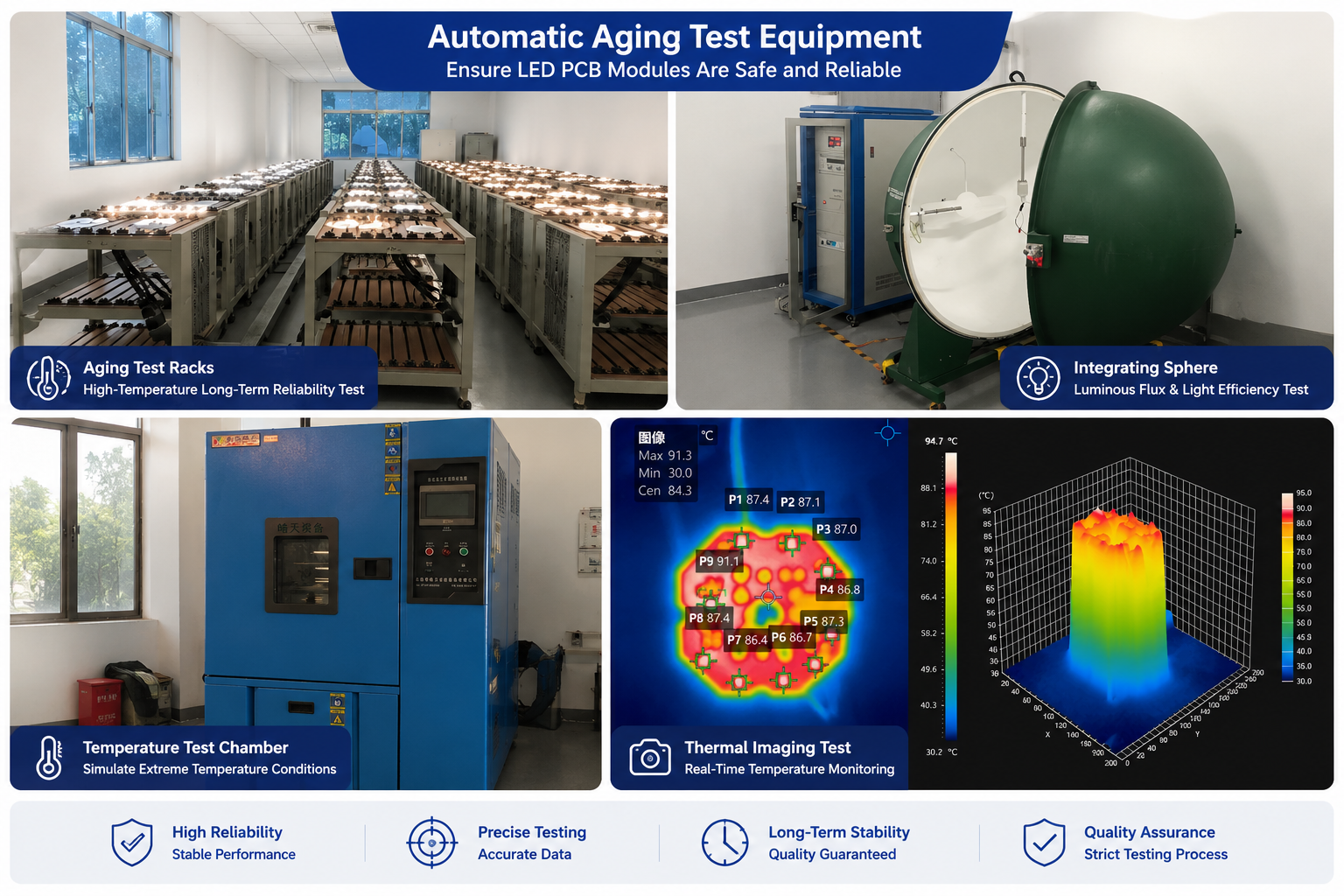
A truly reliable supplier does not guess at EMC performance; they measure it. Verify that your partner possesses in-house testing equipment—such as EMI receivers, line impedance stabilization networks (LISN), and surge simulators. They should be ready to provide official laboratory report data detailing their module's performance across Conducted and Radiated Emissions spectrums.
Summary of Benefits: What EMC Compliance Brings to Your Business
Engineering Aspect | Uncompliant / Low-Cost LED Module | EMC-Compliant LED Module (SMAR Advantage) |
Lab Certification Speed | Frequent failures, iterative redesigns, multi-month market delays | Smooth, first-pass validation across CE, FCC, and UL labs |
Grid & Wireless Harmony | Causes static on radios, drops Wi-Fi signals, triggers nearby sensors | Complete electromagnetic coexistence with smart office/home tech |
Visual Performance | Prone to blinking, flickering, and dimming when grid loads shift | Solid, ripple-free light output under harsh electrical noise conditions |
Long-Term Warranty Risk | High failure rates due to grid voltage stress, high RMA costs | Drastically reduced warranty claims, preserving brand trust |
FAQ
Q1: Can I just add an external EMC filter to a cheap LED module to pass certification?
A: While adding external inline filters can help suppress conducted emissions, it increases your total assembly labor, adds physical volume to the lamp casing, and introduces additional material costs. More importantly, external filters cannot fix high Radiated Emissions (RE) that escape directly from poorly tracked PCB boards. Integrating the filter directly onto a customized DOB board is always the most compact and cost-effective approach.
Q2: How does EMC performance relate to flicker?
Flicker in LED modules is primarily caused by ripple in the LED drive current — variation in current amplitude at twice the mains frequency (100Hz in 50Hz markets, 120Hz in 60Hz markets) or at the driver switching frequency. The filtering circuits that reduce conducted EMI emissions also reduce drive current ripple. A module with strong EMC design typically also has lower flicker. Conversely, a module with visible flicker almost always has poor conducted emissions performance.
Q3: Does higher wattage mean a module will naturally have worse EMC emissions? A: Higher wattage modules handle greater current volumes, which can potentially generate stronger electromagnetic fields. However, wattage itself does not dictate compliance. A high-wattage module (e.g., 100W) with an excellently engineered multi-stage filter can emit far less noise than a poorly designed 10W module that completely lacks common-mode dampening.
Q4: Can a DOB module pass EMC testing in the module alone, or does it need to be tested in a fixture?
Both approaches are used. Module-level testing (testing the DOB module as a component) provides baseline data on the module's intrinsic emissions. Fixture-level testing (testing the complete luminaire with the module installed) accounts for the fixture housing's effect on radiated emissions and is what most certification standards actually require for a finished product. When qualifying a DOB module, ask whether the EMC data provided was generated at module level or fixture level.
Q5: How does SMAR LED Lighting ensure compliance for unique, custom-shaped boards?
A: Every time a board shape changes (e.g., from a standard rectangle to a narrow arc or custom ring), the trace lengths and loop areas alter, which directly changes the EMC profile. Our engineering team conducts full EDA board simulations and runs physical pre-compliance checks in our testing facility on every custom iteration, ensuring your custom geometry remains completely electrically stable.
Conclusion: Partner with an Expert
At SMAR LED Lighting, we believe that an LED module should do more than just emit bright light; it must fit perfectly into the modern electronic landscape without compromise. We specialize in engineering and manufacturing high-performance, customized DOB modules and customized linear solutions tailored specifically around rigid global EMC criteria.
From initial component selection and rigorous schematic design to advanced SMT assembly ,we help global lighting brands and industrial manufacturers bring rock-solid, compliant, and durable products to international markets.
Ready to eliminate compliance risks and ensure ultimate stability for your next lighting product line? Discover our specialized engineering standards and core material selections by exploring our detailed guide on Customized LED Module Solutions. Contact our technical support team today to get a fast, expert engineering review and design evaluation for your next project!
View Our DOB Module Range → DOB Module Manufacturer | AC Direct Driver LED Module Supplier | SMAR
View Our LED PCB Products → LED PCB Manufacturer | Custom Aluminum PCB & MCPCB Supplier | SMAR
Request EMC Documentation for a Specific Module → Contact
Related: How to Choose a Reliable DOB Module Supplier → How to Choose a Reliable DOB Module Supplier: A Complete Guide for Lighting Manufacturers
Related: DOB Module Application Guide → DOB Module Application Guide-Choosing the Right Solution for 5 Key Lighting Scenarios