
info@smarledlighting.com
+86 20 38466982
Toggle Navigation


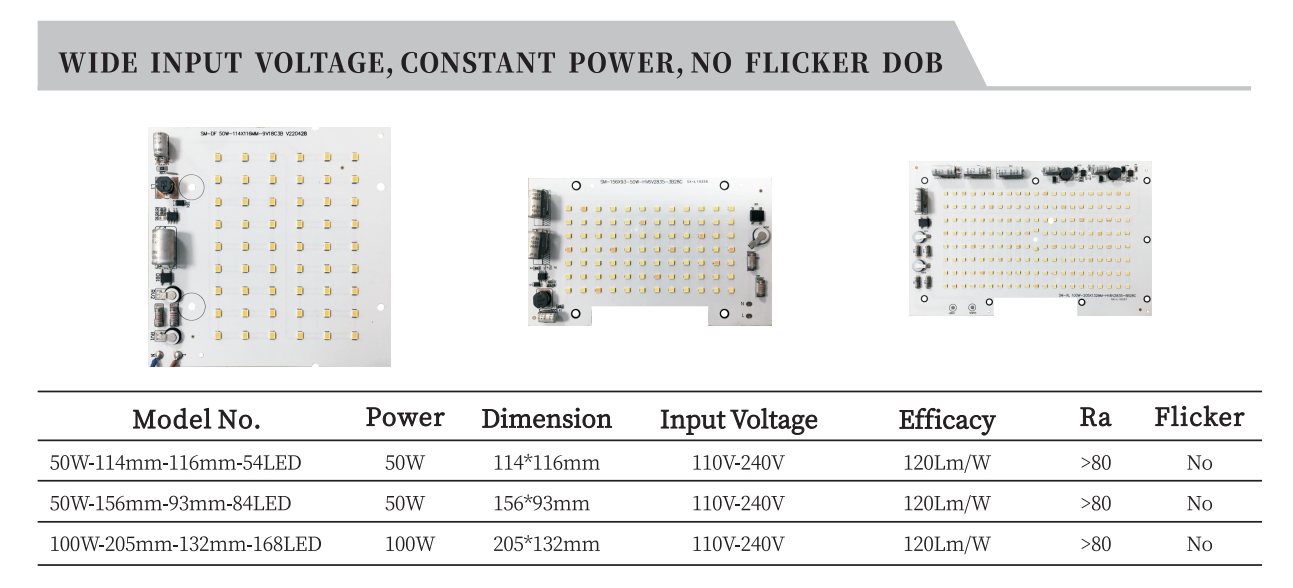
Not all Driver-on-Board (DOB) modules are created equal. As modern lighting fixture designs lean toward minimalism and structural compactness, DOB architecture has transitioned from a niche premium design to a mainstream industry standard. By eliminating the bulky external driver and embedding the driver components directly onto the LED Printed Circuit Board (PCB), DOB technology drastically simplifies the manufacturing supply chain, slashes assembly labor costs, and allows for ultra-slim luminaire designs.
However, this structural integration introduces unique engineering challenges. Because the light-emitting diodes (LEDs) and the driver electronics reside on the very same substrate, they share the same thermal ecosystem. Different lighting projects have completely different needs—varying power levels, operating temperatures, dimming requirements, and environmental installation conditions. Choosing a generic, poorly engineered, or wrong DOB module can lead to catastrophic system overheating, rapid lumen depreciation, short lifespan, or unstable visual performance.
To help lighting manufacturers, product managers, and optical engineers make informed decisions, this comprehensive guide covers 5 common lighting scenarios, breaks down their specific technical priorities, and outlines exactly what to look for when specifying a DOB module.
What Makes DOB Modules Application-Specific?
A DOB (Driver On Board) module integrates the AC-to-DC driver circuit directly onto the LED PCB, eliminating the need for a separate external driver. This integration makes DOB modules compact and cost-efficient — but it also means the module's design must account for the specific electrical, thermal, and environmental conditions of its intended application from the start.
Unlike a separate driver that can be swapped independently, a DOB module's performance characteristics are fixed at the design stage. This is why application matching matters: a module optimized for residential downlights will underperform or fail when used in an industrial high bay running at elevated ambient temperature for 20 hours a day.
Understanding what each application demands — and what to look for in a module specification — is the foundation of reliable product development.
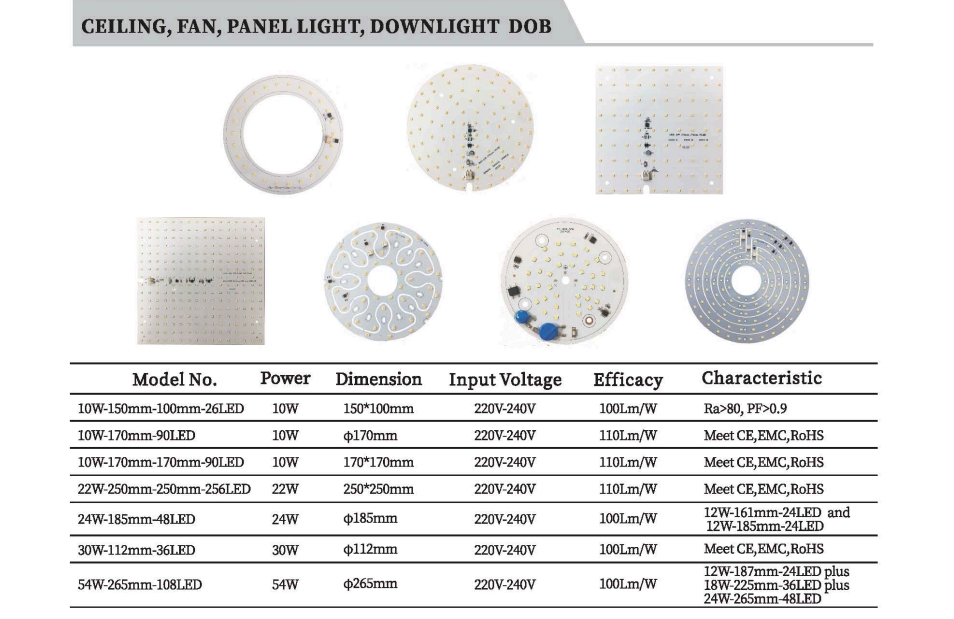
What matters most: Stable light output, high color rendering, dimming compatibility
Commercial spaces impose high visual quality requirements. Office workers spend eight or more hours under artificial lighting — visible flicker causes eye fatigue and headaches, and even imperceptible flicker above the fusion frequency has been linked to reduced concentration and increased error rates in task environments. Retail environments are even more demanding: product color accuracy under the store's lighting directly affects purchase decisions. A garment that looks one color on the shelf and a different color in natural light creates customer dissatisfaction and returns.
What to Look for in a DOB Module for Commercial Use:
High Color Rendering Index (CRI Ra $ge$ 90, R9 $ge$ 50): Ensures accurate, rich color reproduction for retail displays and comfortable working conditions.
True Flicker-Free Performance: Standard AC-direct DOB modules can exhibit a 100Hz/120Hz ripple. Commercial DOBs must use advanced ripple-filtering circuitry to eliminate visible and invisible flicker, which is vital for maintaining compatibility with modern smartphone cameras and scanning systems in retail.
Smooth Dimming Compatibility: Flawless integration with localized architectural dimming protocols, including TRIAC (phase-cut), 0-10V, or digital DALI networks.
Precise Regional Input Voltages: Ensuring the module is optimized for the local grid (e.g., 200–240V for Europe and Asia, or 120V for North America) to maximize driver efficiency and power factor.
Real-World Application Example:
Consider an upscale fashion retail chain installing ultra-slim linear pendant fixtures across its showrooms. Traditional external drivers cannot fit into the sleek, narrow aluminum profiles. A customized linear DOB module with an integrated, flicker-free driver allows the fixture to maintain a minimalist aesthetic. By choosing a module with a CRI of 95 and a specialized 3500K color temperature, the clothing textiles retain their true-to-life colors, boosting sales while preventing the flickering that ruins customer social media photos.
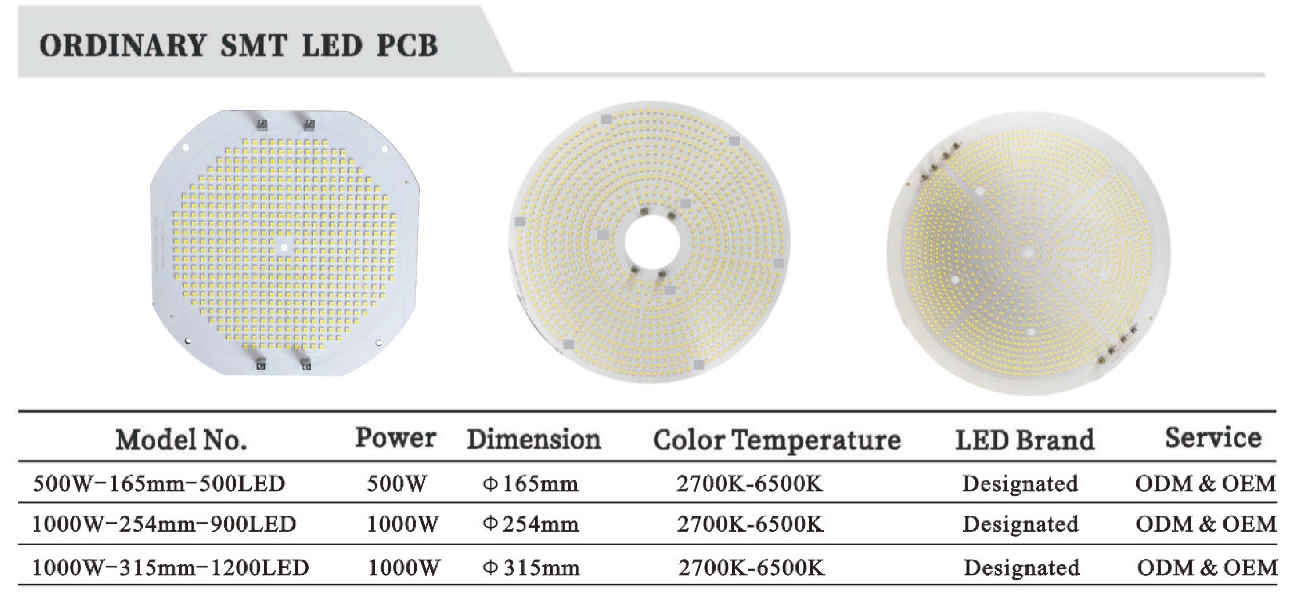
What matters most: High power output, thermal durability, long operational lifespan
Industrial lighting environments impose extreme demands on components. Lights typically operate 12–20 hours per day in conditions that include elevated ambient temperatures (often 40–55°C near machinery), dust accumulation, mechanical vibration, and humidity. A module that performs acceptably in a climate-controlled office will degrade rapidly in a foundry or chemical processing facility.
What to look for in a DOB module for industrial applications:
High wattage range: 40W, 60W, 80W, 100W, 120W, 150W, or higher depending on mounting height and lux requirements
Wide operating temperature range: –20°C to 85°C minimum; –40°C to 85°C for extreme environments
Built-in over-temperature protection that reduces output rather than shutting off abruptly
Over-current and over-voltage protection circuits
Aluminum PCB base material with optimized copper thickness for heat dissipation at high power levels
Vibration resistance — confirm PCB component mounting is rated for mechanical stress in manufacturing environments
Real-World Application Example:
In a heavy-machinery manufacturing plant where ambient ceiling temperatures routinely reach 60°C, generic DOB modules would rapidly fail due to thermal runaway. By implementing a custom high-power circular DOB module built on a high-conductivity $2.0 ext{W/m}cdot ext{K}$ aluminum PCB, heat is efficiently spread. Combined with an intelligent driver IC that automatically clamps the current if temperatures spike, the facility avoids costly production downtime and dangerous lighting blackouts.
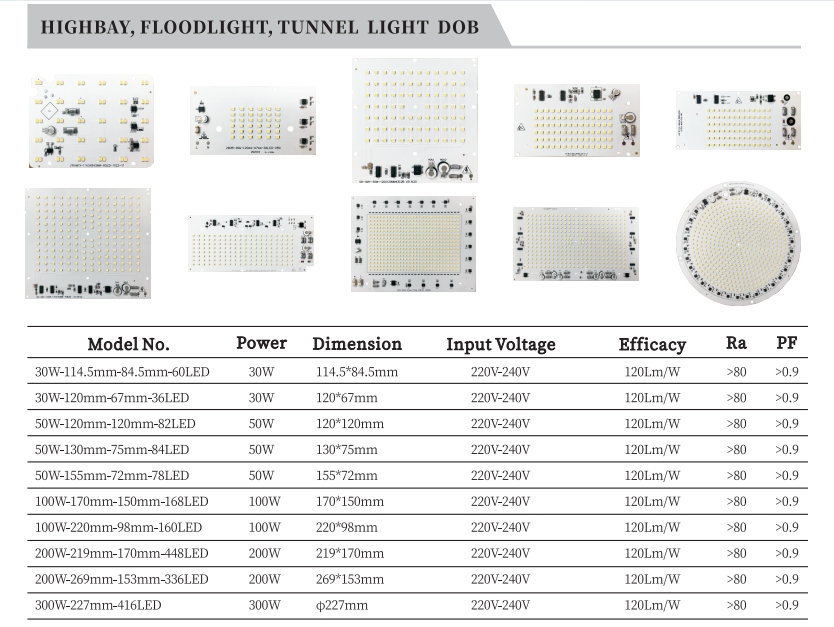
What matters most: Weather resistance, surge protection, energy efficiency
Outdoor lighting faces a combination of challenges that no other application category encounters simultaneously: direct exposure to rain and humidity, wide ambient temperature swings (from –20°C to 50°C+ depending on climate), power surges from lightning strikes, and the economic pressure of all-night operation seven days a week. An outdoor DOB module that fails due to inadequate surge protection or moisture ingress creates costly maintenance situations — street lights on 10-meter poles are expensive to service.
What to look for in a DOB module for outdoor applications:
Surge protection rating: minimum 4kV line-to-line, 6kV preferred for lightning-prone regions
High luminous efficacy: ≥ 130 lm/W, ≥ 140 lm/W for energy-efficiency-regulated markets
Built-in Power Factor Correction (PFC) to meet EN 61000-3-2 or equivalent local regulations (PF ≥ 0.9 typically required)
Wide input voltage range to accommodate grid voltage variation in the installation area
Over-voltage and over-temperature protection for unattended outdoor operation
Component ratings appropriate for the operating temperature range — capacitor specifications are particularly critical; capacitors rated only to 85°C degrade faster in high-ambient outdoor environments
Real-World Application Example:
A municipal highway lighting project requires upgrading 5,000 old high-pressure sodium streetlights to LED. The strict city budget demands a solution that fits into the existing cast-aluminum housings without adding the cost of external driver brackets. A custom-shaped, highly efficient outdoor DOB module with integrated 6KV surge protection and a certified Power Factor of 0.97 is deployed. The city slashes its electricity bill by 55% while ensuring the streetlights survive severe summer electrical storms.
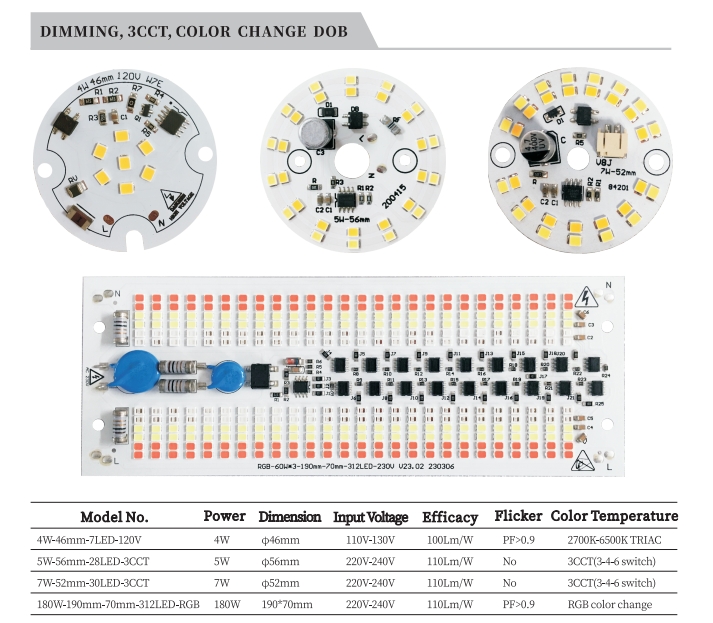
What matters most: Compact size, flicker comfort, quiet operation, warm color quality
Residential lighting has different priorities than commercial or industrial applications. Power levels are lower (typically 8–30W), fixture housings are compact, and the performance criteria that matter most to end users are comfort-oriented: no flicker, no audible noise, warm color temperature, and consistent light quality over the product's life. Residential products are also more price-sensitive than commercial or industrial categories, making cost-efficient DOB module design particularly relevant.
What to look for in a DOB module for residential applications:
Low flicker: SVM (Stroboscopic Visibility Measure) < 0.4, or Percent Flicker < 10% at full load
Silent operation: no audible noise from driver components — confirm with a noise test at the intended operating wattage
Compact form factor: board diameter or dimensions matched to the fixture housing
Warm color temperature options: 2700K and 3000K for living spaces, bedroom, and hospitality environments
CRI Ra ≥ 80 for general residential use; Ra ≥ 90 for kitchen and bathroom applications where accurate color rendering matters
Consistent lumen output over lifetime: check L70 rating (the operating hours at which output drops to 70% of initial lumen output)
Real-World Application Example:
A smart home luminaire brand is designing a compact, low-profile smart bedroom ceiling light. They require a module that fits into a shallow 20mm deep housing while offering Bluetooth mesh connectivity. A custom circular DOB module is engineered, integrating both the AC-direct driver and the wireless control chip on a single board. The engineering team tunes the circuitry to ensure dead-silent dimming and an exceptionally low SVM value, creating a calm, flicker-free bedroom environment.
What matters most: Battery compatibility, instant startup, operational reliability
Emergency lighting is a safety-critical application. Regulatory requirements in most markets mandate that emergency lights reach full output within 0.5 seconds of mains power failure and maintain output for a defined duration (typically 1–3 hours) from backup battery supply. These requirements impose specific electrical characteristics that standard DOB modules designed for mains-only operation do not meet.
What to look for in a DOB module for emergency lighting applications:
Wide input voltage range covering both AC mains and DC battery voltage: e.g., 100–240V AC and 12–48V DC
Fast startup time: < 0.5 seconds from power-on to full output, in both AC and DC modes
Stable output at low DC voltage: maintains rated output down to the battery's end-of-discharge voltage (typically 18–20V for 24V systems)
Long operating lifespan to reduce maintenance frequency — emergency lights in stairwells and corridors are often in difficult-to-access locations
Compliance with emergency lighting standards applicable to the target market (EN 60598-2-22 for Europe, NFPA 101 for North America)
Real-World Application Example:
An architectural emergency exit sign manufacturer requires a unified light engine that interfaces with a local lithium-iron-phosphate (LiFePO4) battery pack. A specialized DOB module is engineered with dual-input circuitry. Under normal conditions, it runs off standard 230V AC while allowing the battery system to charge. The millisecond the AC grid drops, the DOB's onboard logic switches to the battery input, providing instant, uniform backup illumination along critical fire escape corridors.
DOB Module Specification Comparison for Different Lighting Applications
| Application | Typical Power | Recommended PF | Recommended CRI | Key Protection | Typical CCT | Primary Requirement |
| Commercial Lighting | 10–50W | ≥0.90 | Ra ≥90 | Flicker-Free | 4000K–5000K | High Color Quality & Dimming |
| Industrial Lighting | 40–150W | ≥0.95 | Ra ≥80 | Thermal & Overcurrent Protection | 5000K–6500K | Reliability & Long Operating Hours |
| Outdoor Lighting | 30–200W | ≥0.90 | Ra ≥80 | 4–6kV Surge Protection | 4000K–6500K | Weather Resistance & Energy Efficiency |
| Residential Lighting | 5–30W | ≥0.90 | Ra 80 / Ra 90 | Low Flicker & Silent Design | 2700K–3000K | Visual Comfort |
| Emergency Lighting | 3–20W | ≥0.90 | Ra ≥80 | Wide Voltage & Fast Startup | 4000K–6500K | Stable Emergency Operation |
FAQ: Deep-Dive Into DOB Technology and Specification
Q1: Do DOB modules degrade faster than traditional LEDs because the driver components emit heat onto the same board?
A: This is the most common concern regarding DOB technology. If a DOB module is poorly engineered, yes, the heat from the rectifier and driver IC can elevate the junction temperature of the adjacent LEDs, accelerating lumen depreciation.
However, high-quality DOB modules solve this through precise structural engineering. At SMAR LED Lighting, we utilize advanced thermal simulation software to optimize component layout, physically isolating heat-generating components from the LED chips. Furthermore, by utilizing premium aluminum-clad Metal Core PCBs (MCPCB) and pairing them with high-efficiency LEDs that generate less heat per watt, the thermal load is effectively distributed and transferred to the luminaire's external heatsink, matching or exceeding traditional driver-separated setups.
Q2: What surge protection level do I need for outdoor applications?
A: For most outdoor street lighting and area lighting, 4kV line-to-line surge protection is the minimum acceptable specification. In regions with frequent lightning activity or long rural power lines (which act as antennas for surge energy), 6kV is recommended. Confirm that the surge protection is built into the DOB module itself — some suppliers list surge protection ratings that depend on separate external components in the fixture.
Q3: What are the main limitations of DOB modules compared to external drivers?
A: While DOB modules offer massive space and cost savings, they do have trade-offs. Because of the limited physical space on the PCB, they generally cannot accommodate the massive electrolytic capacitors found in large external driver boxes. This means that designing a DOB module with ultra-high power (e.g., above 150W) or achieving absolute 0% ripple requires highly sophisticated circuitry and premium ICs, which can increase the component cost. For standard wattage ranges and applications, however, the benefits of omitting the external box heavily outweigh these limitations.
Q4: How do I verify a DOB module's operating temperature range?
A: Request thermal test data showing LED junction temperature (Tj) and PCB temperature at rated wattage under the specified maximum ambient temperature. Thermal imaging from a production batch (not just an engineering sample) is the most reliable evidence. A module whose rated operating range extends to 85°C ambient should be tested at 85°C, not at room temperature with a theoretical calculation.
Q5: How does a custom DOB module save money on large-scale production runs?
A: Customization optimizes the Total Cost of Ownership (TCO). A standard off-the-shelf module often forces you to pay for features you do not need, or worse, requires you to modify your expensive metal lamp housings to make it fit.
A custom-engineered DOB module matches the exact mounting holes, shape, voltage, and photometric output of your fixture. In production, your assembly line workers skip multiple steps: there is no external driver box to mount, no secondary wiring harnesses to connect, and no manual soldering of driver leads. You simply drop the single module into place and connect the main lines, cutting assembly labor costs drastically.
Let's Engineer Your Next Solution Together
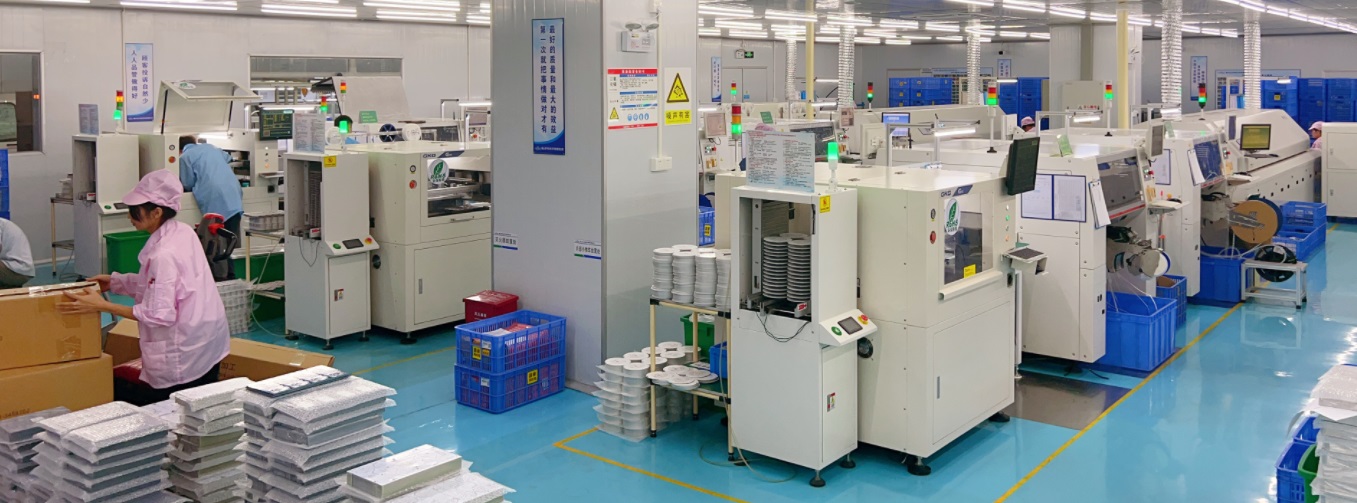
At SMAR LED Lighting, we do not expect your project to fit into a generic template. We specialize in designing and manufacturing fully customized LED PCBs and high-performance DOB modules tailored precisely to your mechanical enclosures and electrical targets. Whether you are an established global lighting brand streamlining an industrial product line or an innovative startup launching a smart home luminaire, our engineering team is here to guide you from initial prototype to flawless mass production.
Ready to elevate your lighting project's performance and reduce your manufacturing costs? Explore our advanced manufacturing facilities and engineering capabilities by visiting our comprehensive guide on Customized LED Module Solutions. Contact our engineering support team today to receive a comprehensive design review and a competitive production quote!
Explore SMAR LED Lighting's DOB Module Range
SMAR LED Lighting manufactures DOB modules for all major lighting application categories, with OEM and custom design support for wattage, CCT, board size, and input voltage.
View Our Full DOB Module Product Range →DOB Module Manufacturer | AC Direct Driver LED Module Supplier | SMAR
Request a Custom DOB Module for Your Application →Contact
Related: How to Choose a Reliable DOB Module Supplier → How to Choose a Reliable DOB Module Supplier: A Complete Guide for Lighting Manufacturers
Related: DOB Module vs Traditional LED Driver → DOB Module vs Traditional LED Driver A Practical Guide for Lighting Manufacturers
Related: Custom LED Module Solutions → Customized LED Module Solutions: How SMAR LED Lighting Creates More Value for Lighting Projects