
info@smarledlighting.com
+86 20 38466982
Toggle Navigation


Choosing between a DOB (Driver on Board) module and a traditional LED driver is one of the most important design decisions during LED lighting product development. The solution you choose directly affects fixture size, manufacturing cost, assembly efficiency, product reliability, maintenance requirements, and market competitiveness.
For OEM lighting manufacturers, wholesalers, and lighting brands, understanding the strengths and limitations of each technology helps optimize product performance while reducing production costs.
This guide compares DOB modules and traditional LED drivers from both engineering and commercial perspectives, helping you select the best solution for your next lighting project.
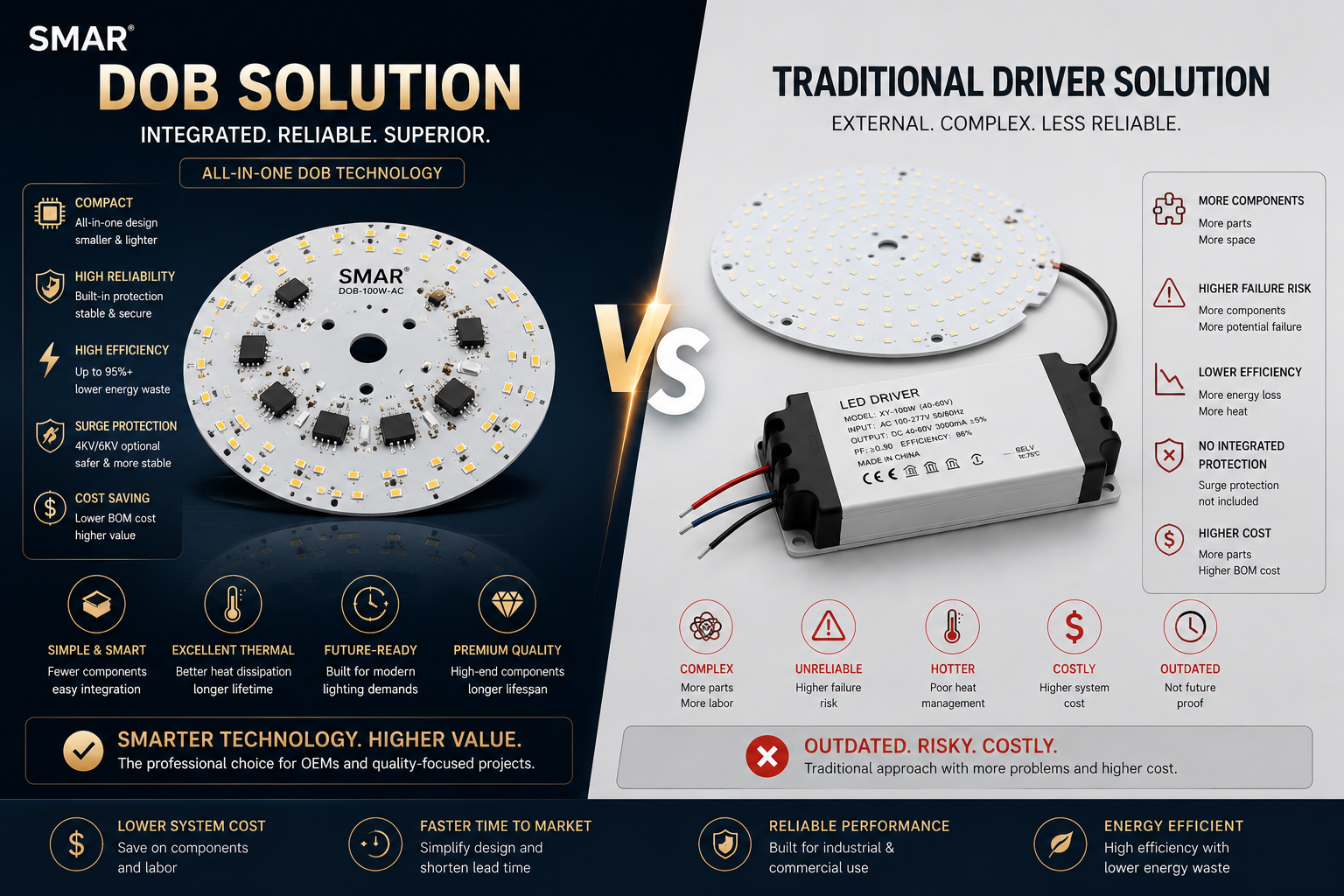
Figure 1: DOB modules (left) vs traditional LED driver boards (right)
A DOB module integrates the driver circuitry directly onto the LED PCB. The module connects to AC mains power with no separate driver enclosure required — reducing component count, assembly steps, fixture depth, and total weight.
DOB technology is now widely used in street lights, high bay and UFO fixtures, flood lights, downlights, panel lights, garden lights, and wall lights — particularly in cost-competitive OEM and commercial lighting projects where slimmer profiles and faster assembly matter.
The key engineering advantage of DOB is integration: by putting the power conversion circuit and the LEDs on the same board, the entire thermal and electrical system can be optimized together rather than separately. A well-designed DOB module from a professional supplier achieves Power Factor above 0.95, flicker below 5%, and junction temperatures low enough to support 50,000+ hour LED lifespans.
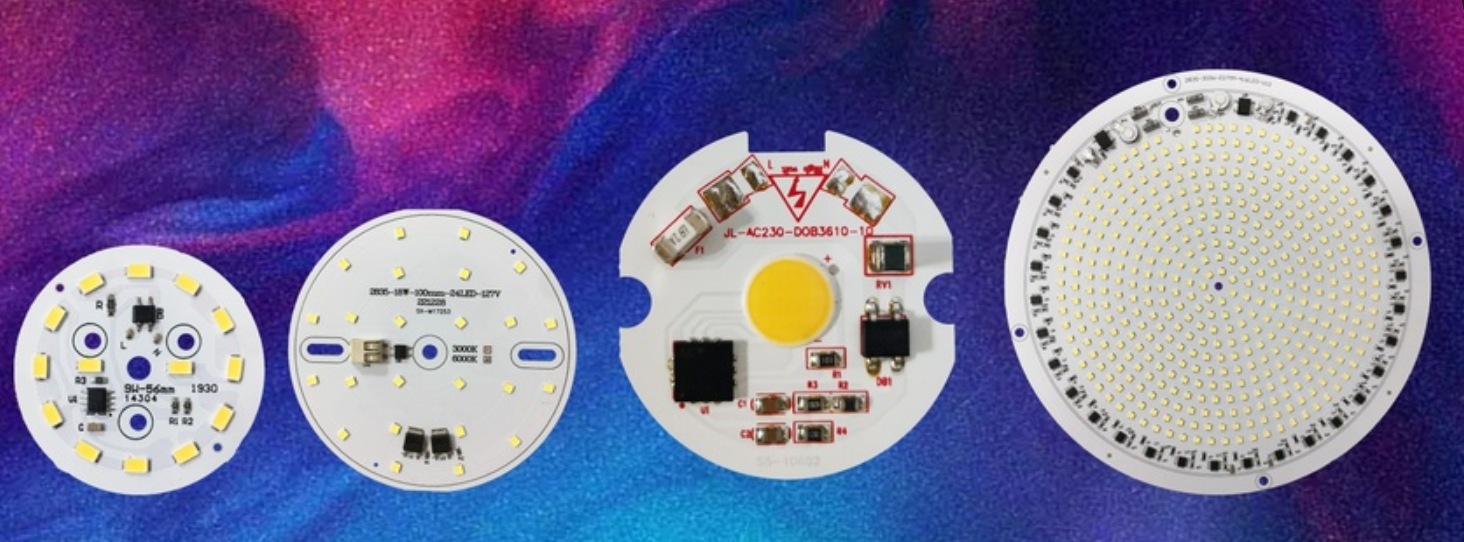
Figure 2: SMAR LED Lighting DOB module range — from small ceiling light modules to large highbay formats
A traditional LED driver is a separate encapsulated unit that converts AC mains power into the regulated DC current LEDs require. It sits inside the fixture, connected by wires, and is rated and certified independently from the LED board.
Traditional drivers remain the standard for advanced dimming protocols (DALI, 0–10V, Triac), smart lighting integration, and premium applications where field serviceability is important. Because the driver is a separate replaceable component, maintenance teams can swap a failed driver without replacing the entire light source.
The trade-off is size and complexity: housing a separate driver requires more internal fixture volume, more wiring, more assembly labor, and a higher combined BOM cost.
Use this table when evaluating DOB modules against traditional drivers for a specific project. Parameters are based on commercially available mid-range products from professional suppliers.
Factor | Traditional LED Driver | DOB Module |
Fixture size | Larger — separate enclosure | Compact, slim design ✓ |
Assembly | More wiring, more labor | Simpler, faster production ✓ |
BOM cost | Higher — two components | Lower overall cost ✓ |
Dimming | Full support (DALI, 0–10V, Triac) ✓ | Basic dimming available |
Power factor | High PF with quality drivers ✓ | High PF achievable (>0.9) ✓ |
Flicker control | Excellent in premium models ✓ | Depends on supplier design quality |
Customization | Limited to catalog selection | Wattage, CCT, size, LED brand — all adjustable ✓ |
Repairability | Driver replaceable in field ✓ | Full module replacement |
Production efficiency | Moderate | High ✓ |
The right choice is not universal — it depends on your fixture type, target market, and production volume. Here is how the decision plays out across the most common lighting categories.
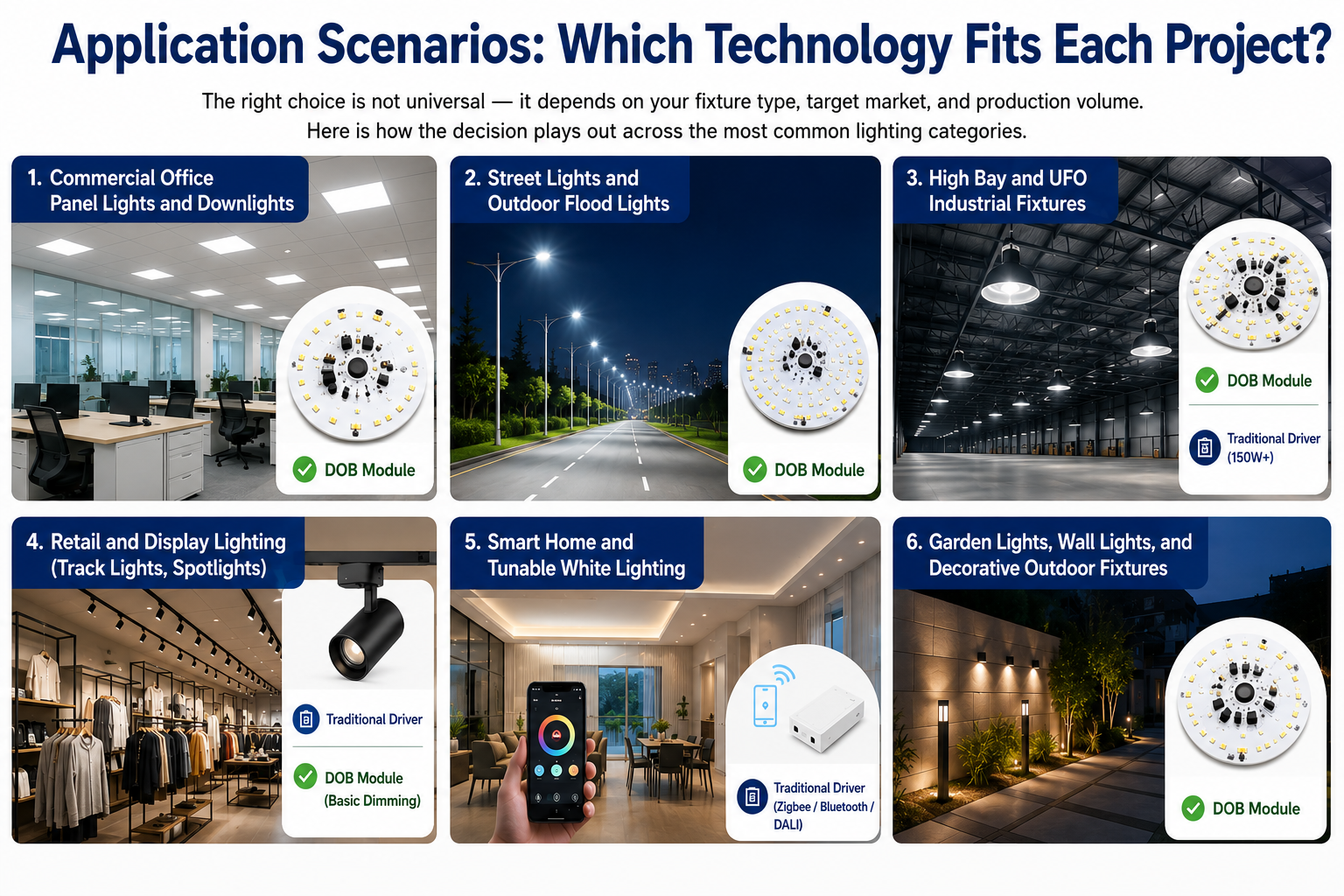
Commercial Office Panel Lights and Downlights
DOB modules are the dominant choice in this segment. Slim panel designs (under 12mm profile) require integrated electronics — there is simply no space for a separate driver enclosure. DOB modules with PF ≥ 0.95 and flicker < 5% meet the performance requirements for office lighting standards in most markets. Production efficiency at scale is significantly higher than driver-based designs.
Street Lights and Outdoor Flood Lights
DOB modules are extremely well-suited here. Street light and flood light housings are designed to dissipate heat through the chassis, which works naturally with DOB's on-board thermal management. DOB modules in this category should include surge protection (4kV minimum), over-temperature protection, and conformal coating for humidity resistance. Traditional drivers are rarely used in new outdoor OEM designs due to cost and size disadvantages.
High Bay and UFO Industrial Fixtures
Both technologies compete here. At lower wattages (40–100W), DOB modules offer significant cost advantages. At higher wattages (150W+), premium standalone drivers often provide better efficiency and longer lifespan — the 3–5% efficiency difference becomes meaningful at this power level. For budget-tier industrial customers, DOB dominates. For premium industrial and sports lighting, traditional drivers retain an advantage.
Retail and Display Lighting (Track Lights, Spotlights)
Traditional drivers are generally preferred when dimming is required for retail atmosphere control. DALI and 0–10V dimming systems are standard in modern retail fit-outs. DOB modules with basic phase-cut dimming are suitable for budget retail projects but cannot integrate with advanced building management systems.
Smart Home and Tunable White Lighting
Traditional drivers with built-in wireless control (Zigbee, Bluetooth, DALI) are the only viable option for smart lighting integration. DOB technology does not currently support these protocols at the component level. If your product roadmap includes smart lighting, design around a quality traditional driver from the start.
Garden Lights, Wall Lights, and Decorative Outdoor Fixtures
DOB modules are ideal here. These fixtures prioritize compact size, low weight, and low cost. The simplified assembly of DOB reduces manufacturing cost on high-volume decorative outdoor products. Wattage ranges in this segment (5–30W) are well within the sweet spot of DOB module performance.
If you are still undecided after reviewing the specifications and scenarios above, use this decision logic:
Choose a traditional LED driver when your project requires DALI, 0–10V, or Triac dimming; when smart lighting integration is on the specification; when the fixture will be installed in premium commercial or architectural environments where field serviceability matters; or when wattage exceeds 150W and maximum efficiency is critical.
Choose a DOB module when your priority is compact fixture design; when cost reduction is a key project objective; when you are producing at OEM volume and assembly efficiency matters; when the application is street lighting, flood lighting, high bay, downlight, or panel light at mid-range specification; or when the target market is price-sensitive and dimming is not required.
For the majority of commercial and outdoor OEM lighting products, DOB modules offer the better combination of profile, cost, and production efficiency. The caveat is always supplier quality — a poorly engineered DOB module will underperform a premium traditional driver on every metric. The technology comparison only holds when both products are specified at equivalent quality tiers.
Yes. When designed with quality components and proper thermal management, DOB modules can provide long service life comparable to traditional drivers.
Yes. Professional manufacturers can design DOB modules with PF above 0.9 to meet commercial lighting requirements.
Yes, with the right specifications. DOB modules used in outdoor fixtures should include surge protection (minimum 4kV line-to-line), over-voltage and over-temperature protection, and should be installed in fixtures rated for the relevant IP class. The module itself is not IP-rated — the fixture housing provides environmental protection.
Lifespan depends heavily on operating temperature. Because the driver circuit shares the same PCB as the LEDs, thermal management is critical. A DOB module running at high junction temperature will degrade faster than a separately housed driver. Professional DOB designs with proper aluminum PCB base material and adequate heat dissipation in the fixture achieve 50,000+ hour lifespans. Poor thermal design is the primary cause of early DOB module failure — this is why PCB material and fixture thermal coupling matter.
Yes — this is one of DOB's core advantages over catalog driver products. A professional DOB manufacturer can adjust wattage, color temperature, LED brand, board diameter or shape, and input voltage range to match your fixture design. Minimum order quantities for custom projects vary by supplier, but professional manufacturers typically support custom development from 100 pcs per design.
Evaluate engineering capability, production consistency, thermal management, testing reports, customization support, and communication efficiency rather than focusing only on price.
DOB modules are available up to 200W+, but at these power levels the thermal management requirements are demanding and efficiency losses are more significant. For wattages above 150W, compare total system cost including thermal management carefully against a premium traditional driver solution. For most buyers in this range, a detailed engineering discussion with the supplier is advisable before committing to a design direction.
There is no universal "best" solution between DOB modules and traditional LED drivers. The right choice depends on your product positioning, budget, performance requirements, and target market.
For cost-sensitive OEM production, compact fixtures, and high-volume manufacturing, DOB modules offer significant advantages in production efficiency and overall cost.
For premium commercial lighting requiring intelligent controls and advanced dimming, traditional LED drivers continue to provide greater flexibility.
Regardless of the technology selected, long-term product quality ultimately depends on the supplier's engineering capability, manufacturing consistency, and quality control system.
SMAR LED Lighting specializes in OEM and ODM manufacturing of DOB modules, COB modules, and LED PCBs for lighting manufacturers worldwide.
View Our DOB Module Range → DOB Module Manufacturer | AC Direct Driver LED Module Supplier | SMAR
View Our LED PCB Products → LED PCB Manufacturer | Custom Aluminum PCB & MCPCB Supplier | SMAR
Related: How to Choose a Reliable DOB Module Supplier →
How to Choose a Reliable DOB Module Supplier: A Complete Guide for Lighting Manufacturers