
info@smarledlighting.com
+86 20 38466982
Toggle Navigation


Introduction
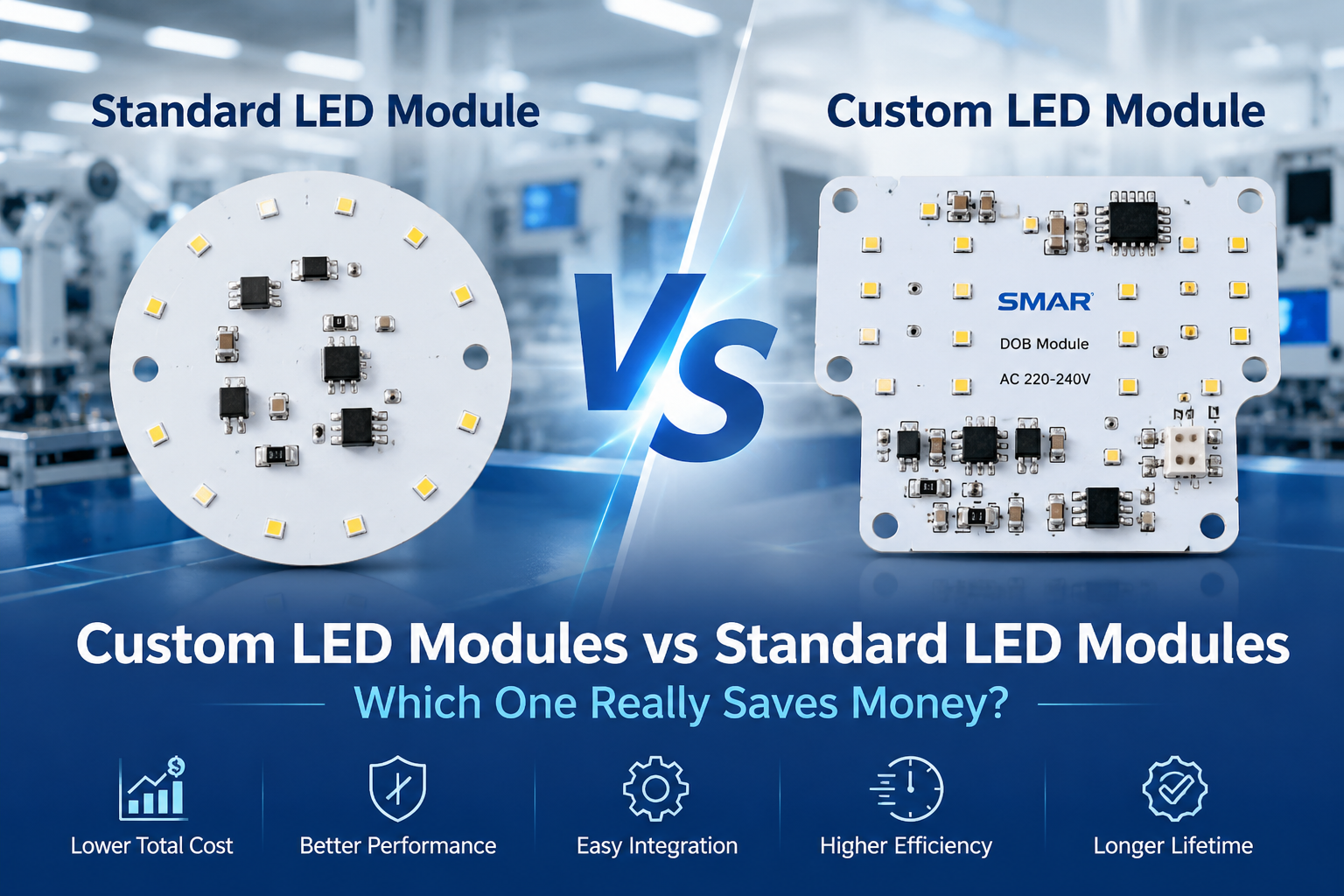
Two LED modules may differ in price by only $0.40, but that small difference can determine whether a lighting project generates long-term profit or unexpected costs.
Many buyers naturally choose the module with the lowest unit price. However, experienced lighting manufacturers know that the purchase price is only one part of the equation. The real cost of a lighting product is also influenced by thermal management, assembly efficiency, product reliability, certification, inventory, and long-term maintenance.
This is why more OEM and ODM manufacturers evaluate projects based on Total Project Cost (TPC) rather than unit price alone. In our experience working with lighting manufacturers across Europe, the Middle East, and Southeast Asia, engineering optimization often delivers greater savings than simply negotiating a lower module price.
In this guide, we'll compare custom LED modules and standard LED modules from both engineering and commercial perspectives, showing how the right design can reduce manufacturing costs, improve reliability, and create greater long-term value.

Why Unit Price Is Only One Part of the Equation
One of the biggest mistakes procurement teams make is comparing LED modules using only the quotation price.
Consider these two options:
Standard Module | Custom Module | |
Module Price | $3.20 | $3.60 |
At first glance, the standard module appears to save $0.40.
However, this comparison ignores nearly every other cost associated with developing and manufacturing a lighting product.
An LED module influences almost every stage of the product lifecycle, including product development, mechanical design, PCB layout, manufacturing efficiency, certification, logistics, installation, warranty service, and long-term maintenance.
A professional cost evaluation should include:
Product development and engineering cost
Mechanical modification cost
Assembly labor
Thermal management requirements
Driver efficiency
Certification and re-testing costs
Warranty expenses
Inventory carrying cost
Long-term maintenance cost
For manufacturers producing tens of thousands of luminaires every year, improving production efficiency by only a few percent can generate savings far greater than the difference in module purchase price.
SMAR Engineering Experience
During OEM projects, we frequently discover that customers focus on reducing the module price by a few cents while overlooking much larger savings available through simplified assembly or improved thermal design. In several projects, optimizing the PCB layout reduced assembly time by more than 20 seconds per fixture—creating annual savings that far exceeded the module price difference.
Standard LED Modules vs Custom LED Modules
Before comparing costs, it's important to understand how these two solutions differ from an engineering perspective.
Parameter | Standard LED Module | Custom LED Module |
PCB Size | Fixed dimensions | Designed specifically for the fixture |
LED Layout | Generic | Optimized for optical performance |
Power Output | Limited standard options | Fully customizable |
Color Temperature | Standard CCT | Project-specific |
CRI | Usually Ra80 | Ra80 / Ra90 / Ra95+ |
PCB Material | Standard | Selected for thermal requirements |
Driver Design | Universal | Application-specific |
Thermal Design | General-purpose | Optimized for actual operating conditions |
Assembly | Often requires adaptation | Plug-and-play integration |
Certification | General market | Designed for target market regulations |
Standard modules remain an excellent choice for products with common specifications and low development budgets.
However, when projects require higher efficiency, compact dimensions, better thermal performance, or compliance with specific regional regulations, a custom LED module usually provides greater long-term value.
For example, lighting products entering European markets often need to comply with ErP Ecodesign requirements, while projects targeting commercial buildings may require improved flicker performance or EMC compliance. Designing these requirements into the module from the beginning is often more efficient than modifying a standard product later.
The 7 Ways Custom LED Modules Reduce Total Project Cost
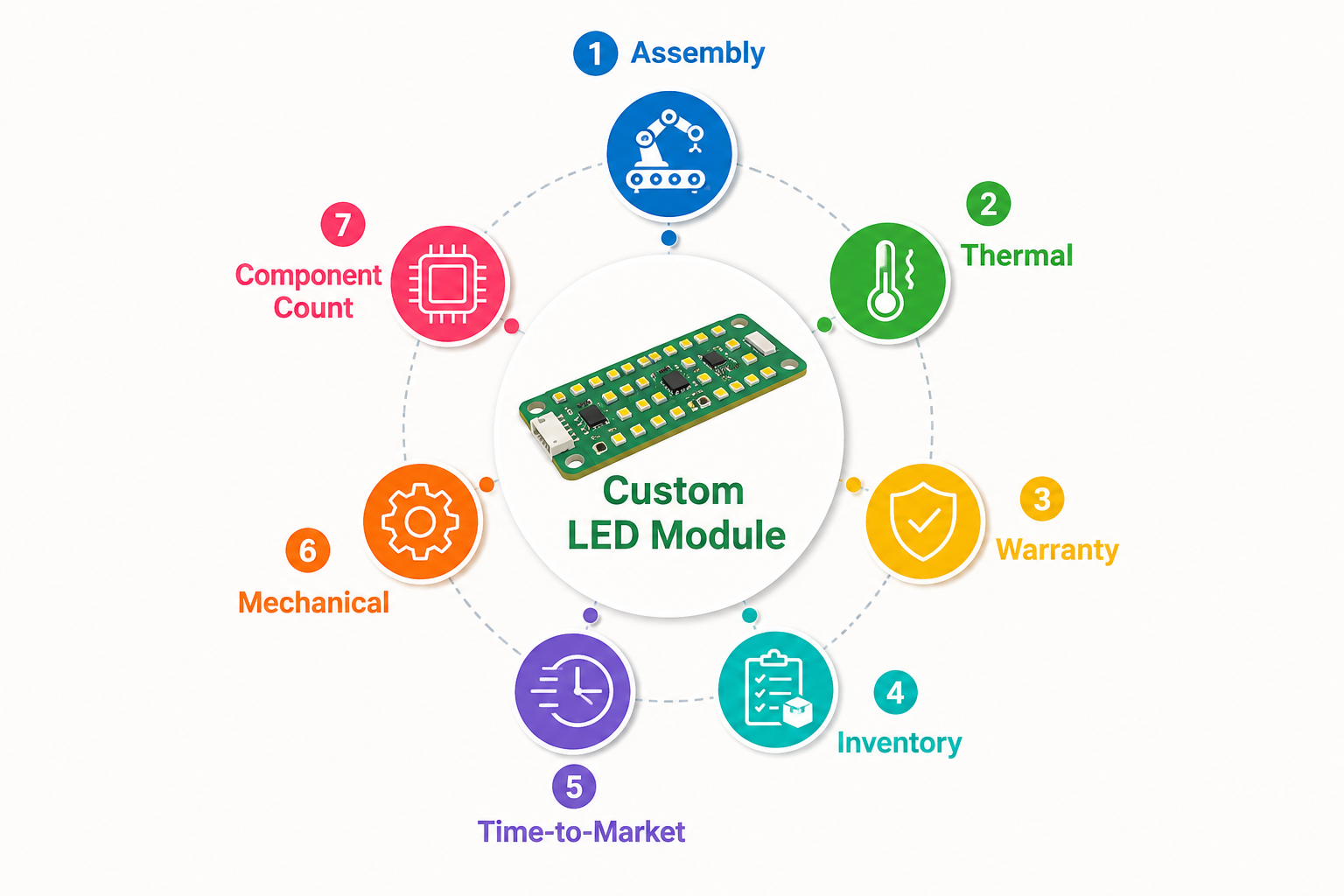
1. Eliminate Mechanical Modification Costs
Standard LED modules are designed to fit as many luminaires as possible—not your luminaire specifically.
As a result, manufacturers often redesign the fixture around the module instead of designing the module around the fixture.
This frequently requires:
Additional mounting brackets
Extra screws
Plastic spacers
Adapter plates
Secondary machining
Housing modifications
Each additional component increases both material cost and assembly time.
A custom LED module is designed around the exact dimensions of the luminaire. PCB shape, mounting holes, connector locations, and wiring layout are optimized for the specific fixture, eliminating unnecessary mechanical parts and simplifying production.
SMAR Engineering Experience
In one OEM panel light project, redesigning the PCB mounting pattern eliminated two brackets and four screws per fixture. Although the custom PCB cost slightly more, the customer reduced assembly time by nearly half a minute per unit and significantly simplified production.
2. Reduce Component Count Through Better Optical Design
Many engineers assume brighter lighting always requires more LEDs.
In reality, a well-designed custom LED module can often achieve the same luminous output using fewer components.
Engineers can optimize:
LED spacing
Beam distribution
Current allocation
PCB layout
Optical efficiency
For example, replacing a standard 36-LED design with an optimized 30-LED configuration can maintain the same lumen output while reducing component count.
Benefits include:
Lower LED cost
Smaller PCB area
Fewer solder joints
Reduced driver loading
Improved manufacturing efficiency
SMAR Engineering Experience
Our engineering team often evaluates the complete optical system rather than the PCB alone. In several commercial lighting projects, optimizing the LED layout improved luminous efficacy enough to reduce the total LED count without affecting illumination performance.
3. Improve Thermal Management and Extend Product Lifetime
Heat remains the primary cause of lumen depreciation, color shift, and premature LED failure.
Standard modules are usually designed for average operating conditions rather than the actual thermal environment inside a specific luminaire.
A custom LED PCB allows engineers to optimize:
PCB thickness
Aluminum substrate
Copper weight
Thermal conductivity
LED spacing
Current density
Heat spreading paths
Lower junction temperatures directly improve:
LED lifetime
Lumen maintenance
Color consistency
Driver reliability
Overall system stability
According to the LM-80 testing methodology, lumen maintenance is strongly influenced by operating temperature. This is why effective thermal management plays a critical role in maintaining long-term lighting performance.
SMAR Engineering Experience
During thermal validation, our engineers routinely perform infrared thermal imaging to identify localized hot spots around high-current traces. In many projects, relatively small PCB layout adjustments have reduced peak operating temperatures by several degrees, improving long-term reliability without increasing manufacturing cost.
4. Simplify Assembly and Reduce Labor Costs
As labor costs continue to increase worldwide, production efficiency has become one of the most important factors affecting manufacturing profitability.
Many standard LED modules require manual adjustments because connectors, cable routing, or mounting holes do not match the fixture design.
A custom LED module can instead be designed for the production line itself.
Features may include:
Pre-positioned connectors
Optimized cable routing
Integrated mounting holes
Tool-free installation
Simplified wiring
Although each luminaire may save only 20–30 seconds during assembly, these savings become substantial across large production volumes.
SMAR Engineering Experience
One of our ODM customers requested that connector positions match the sequence of their automated assembly line. After redesigning the PCB layout, production became smoother, assembly errors decreased noticeably, and manufacturing efficiency improved without requiring any additional production equipment.
5. Lower Warranty Costs Through Higher Reliability
For many lighting manufacturers, warranty and after-sales service represent one of the largest hidden costs—yet these expenses are rarely considered during the purchasing stage.
A standard LED module may perform well during initial laboratory testing, but real-world operating conditions are often much more demanding. High ambient temperatures, voltage fluctuations, humidity, dust, and continuous operation can expose weaknesses that were not apparent during product development.
Common warranty issues include:
Visible LED flicker after several months of operation
Premature lumen depreciation
Driver failure caused by overheating
Color inconsistency between production batches
EMC-related interference
Moisture-induced corrosion in outdoor environments
Each warranty claim creates far more expense than simply replacing the module itself. Manufacturers may also face:
Shipping and logistics costs
Replacement fixtures
On-site maintenance labor
Technical support
Customer compensation
Damage to brand reputation
For commercial lighting projects involving thousands of luminaires, reducing the warranty rate by even one percentage point can generate substantial long-term savings.
A custom LED module allows engineers to optimize reliability by selecting higher-grade electronic components, improving PCB layout, enhancing surge protection, and validating performance through thermal, aging, and EMC testing before mass production.
SMAR Engineering Experience
Many OEM customers initially compare only the purchase price of the module. However, after reviewing previous warranty data, they often discover that reducing the failure rate has a much greater financial impact. In one commercial lighting project, optimizing thermal design and upgrading several key components significantly reduced warranty claims, resulting in lower overall project costs despite a slightly higher module price.
Industry Reference
For lighting products entering European and international markets, compliance with standards such as IEC 61547 (EMC Immunity) and IEC 61000 helps improve product reliability under real operating conditions and reduces the risk of unexpected field failures.
6. Simplify Inventory Management and Reduce Supply Chain Costs
Inventory is another hidden cost that is frequently underestimated.
Manufacturers producing multiple product families often stock numerous standard LED module models to support different wattages, dimensions, and mounting structures.
This leads to:
Higher inventory investment
More warehouse space
Increased purchasing complexity
Greater risk of obsolete stock
Longer production planning cycles
A custom LED module platform can often support an entire product family with only minor component variations.
For example, a manufacturer producing 20W, 30W, and 40W panel lights may use a common PCB platform while adjusting only the LED quantity or current settings.
This approach offers several advantages:
Fewer SKUs
Simplified procurement
Faster inventory turnover
Better cash flow
Reduced warehouse costs
Instead of managing multiple unrelated standard modules, manufacturers gain a more flexible and efficient supply chain.
SMAR Engineering Experience
Several customers have asked us to redesign existing product families around a common PCB platform. By standardizing the PCB outline and connector positions, they significantly reduced inventory complexity while improving purchasing efficiency and production planning.
7. Accelerate Time-to-Market
In today's highly competitive lighting industry, speed is often just as valuable as cost reduction.
Many manufacturers assume custom development will delay production. In reality, the opposite is often true.
When working with an experienced LED module manufacturer, electrical design, PCB layout, thermal optimization, optical analysis, and mechanical integration can all be completed simultaneously during product development.
Instead of repeatedly modifying a standard module to fit the luminaire, engineers design the right solution from the beginning.
Professional engineering support may include:
PCB layout optimization
Thermal simulation
Optical recommendations
EMC design review
Prototype production
Reliability testing
Certification support
This integrated development process reduces engineering revisions and shortens the overall product development cycle.
For seasonal lighting products or competitive commercial tenders, launching even a few weeks earlier can make the difference between winning and losing a project.
SMAR Engineering Experience
For several ODM projects, our engineering team participated from the initial fixture concept stage rather than after the housing had been completed. Early collaboration eliminated multiple design revisions and helped customers complete product validation more quickly, allowing them to enter the market ahead of competitors.
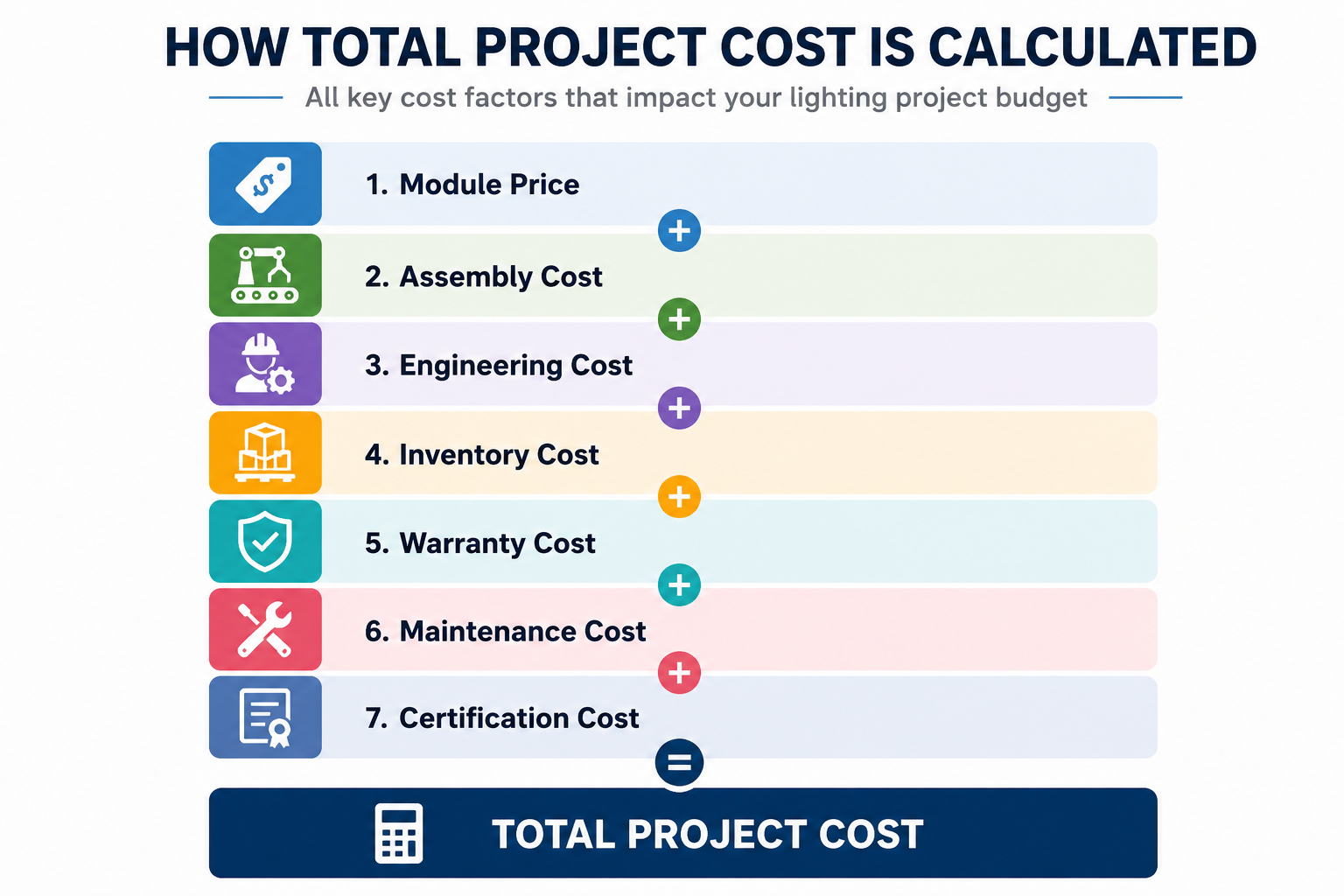
Hidden Costs Most Buyers Ignore
Many purchasing teams compare only one figure:
Module Price
Professional product managers compare Total Project Cost.
The following hidden costs often have a much greater impact on profitability than the LED module itself.
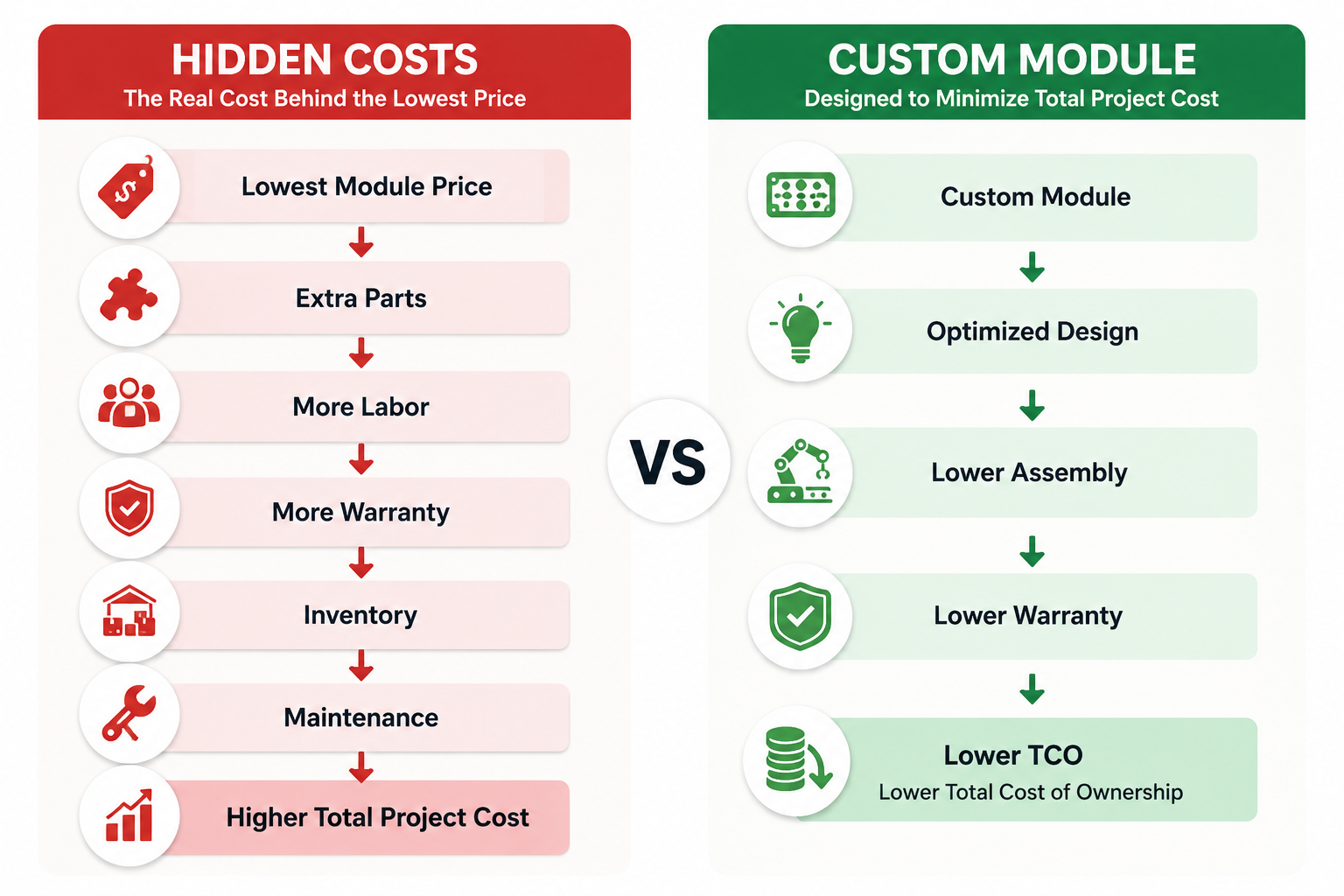
When all these factors are considered together, the module with the lowest purchase price is often not the most economical solution.
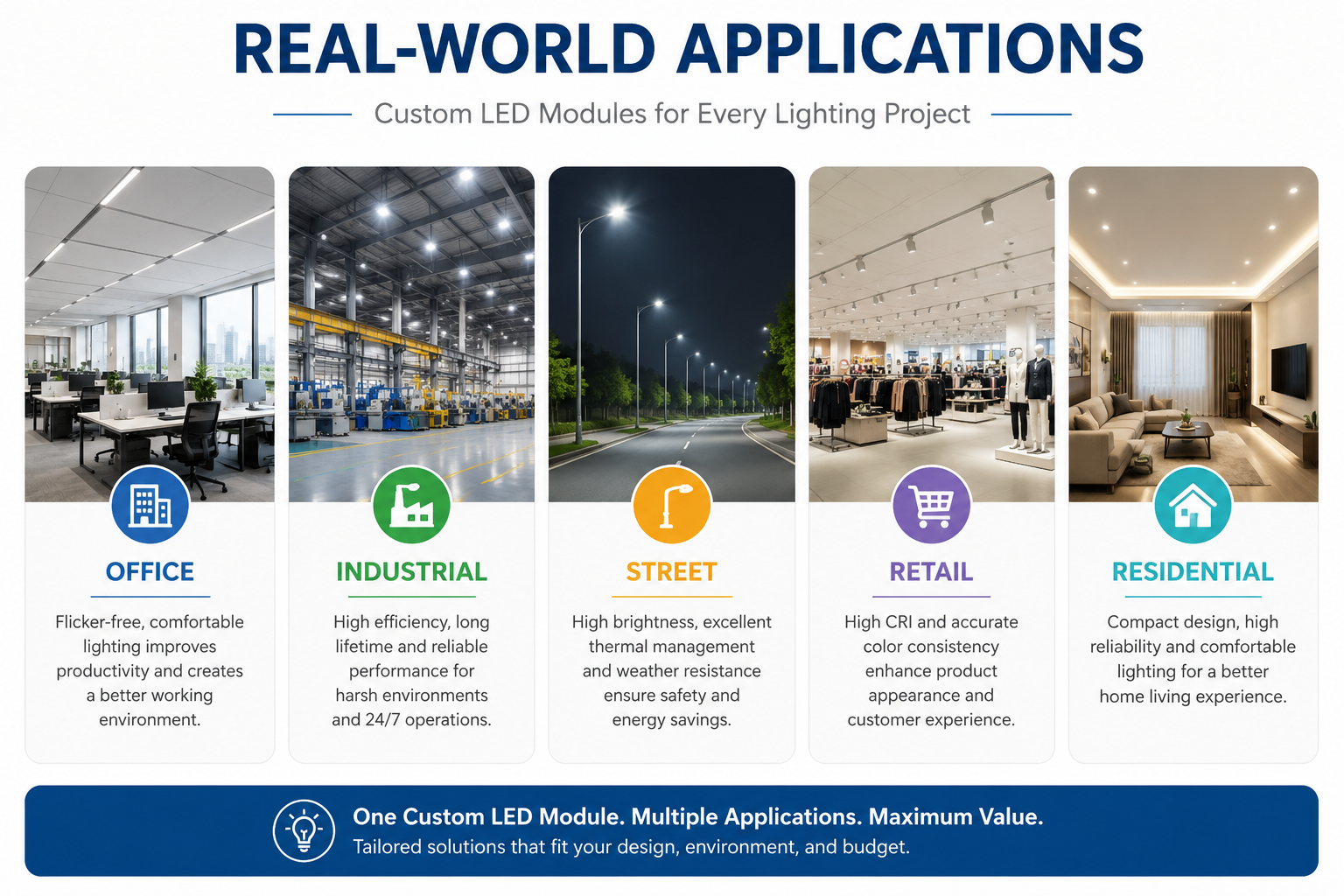
Real-World Application Scenarios
Commercial Office Lighting
Office lighting requires high efficiency, excellent color consistency, and long-term reliability.
A custom LED module can be designed specifically for the fixture dimensions, improving light distribution while simplifying assembly.
Engineering Benefit
Optimized PCB layouts reduce unnecessary mechanical components and improve thermal performance, helping manufacturers lower production and maintenance costs.
Industrial High Bay Lighting
Factories and warehouses often operate lighting systems for more than 16 hours every day.
High ambient temperatures place significant stress on LEDs and driver electronics.
Engineering Benefit
Custom LED modules with optimized aluminum PCBs, improved thermal conductivity, and high-temperature electronic components provide better long-term reliability than standard catalog products.
Street and Outdoor Lighting
Outdoor lighting systems operate under harsh environmental conditions including rain, dust, lightning, and high temperatures.
Engineering Benefit
Application-specific PCB design, enhanced surge protection, and optimized thermal management improve product lifetime while supporting compliance with regional standards.
Retail Lighting
Retail environments require consistent brightness and excellent color rendering to present products attractively.
Engineering Benefit
Custom LED modules allow manufacturers to specify LED brands, CRI, CCT, and PCB layouts that improve visual performance while reducing maintenance frequency.
Smart Residential Lighting
Modern smart lighting products require compact dimensions, wireless compatibility, and low electromagnetic interference.
Engineering Benefit
Custom PCB layouts provide greater flexibility for integrating sensors, wireless modules, and dimming functions while maintaining reliable thermal performance.
How to Evaluate Whether a Custom LED Module Is Worth It
Every project has different priorities. Before deciding between a standard LED module and a custom LED module, evaluate your project using the checklist above.
If your answer is "Yes" to several of these questions, investing in a custom LED module will often reduce the Total Project Cost (TPC) while improving long-term reliability and manufacturing efficiency.
Frequently Asked Questions
Q1: Is a custom LED module always more expensive per unit than a standard module?
Not necessarily. While the module itself may carry a modest price premium — typically 10–35% depending on customization scope and volume — custom designs routinely reduce total project cost by lowering assembly time, component count, thermal management requirements, and warranty expenses. The net economic result is frequently lower total cost, not higher.
Q2: What production volume justifies custom LED module development?
Projects with annual demand above 2,000–5,000 units typically see clear economic justification. Below 500 units, development cost per unit usually outweighs project savings unless the application has high warranty cost risk or strict certification requirements. Between 500 and 2,000 units, the value depends on the specific project — outdoor and industrial applications with significant warranty exposure often justify customization even at lower volumes.
Q3: How long does custom LED module development take?
Minor customizations based on an existing platform — CCT adjustment, small dimension change — typically require 3–7 working days for samples. New PCB layouts with standard components: 10–15 working days. Designs requiring new component sourcing or extensive electrical validation: 3–5 weeks. Certification testing adds time depending on the target market's laboratory schedule. Factor certification timeline into the project plan from the start.
Q4: Can a custom module platform serve multiple products in my range?
Yes — and this is one of the strongest arguments for custom development. A module platform designed around a manufacturer's core product family can serve multiple fixture models with minor variants for wattage, CCT, or board size. This approach reduces development cost per product, simplifies supplier management, and consolidates volume for better pricing.
Q5: Does switching to a custom module require new certification for each variant?
Not always. Minor variants within the same circuit topology — wattage adjustment, CCT change — can often be covered under a family certification if the changes are within the scope of the original test report. Significant circuit design changes typically require re-testing. Your module supplier and certification laboratory can advise on what constitutes a significant change for your target market.
Q6: Are custom LED modules suitable for OEM and ODM projects?
Yes — OEM and ODM manufacturers are among the primary users of custom LED modules precisely because customization enables product differentiation while improving manufacturing efficiency. A module designed specifically for your product cannot be easily replicated by competitors using standard catalog sourcing.
Q7: What should I look for in a custom LED module manufacturer?
Prioritize engineering capability over price. Key indicators: in-house PCB design and layout capability, thermal simulation and infrared testing, SMT production with AOI inspection, aging test facilities, and documented certification experience for your target markets. A supplier who can answer technical questions about junction temperature, EMC design, and surge protection with precision has genuine engineering depth. One who only sends a price list does not.
Conclusion
When comparing custom LED modules with standard alternatives, the real question is not which product has the lowest purchase price — it is which solution delivers the lowest total project cost.
A well-designed custom LED module reduces costs across the entire product lifecycle: better thermal management extends product lifetime, simplified assembly reduces labor cost, optimized component count lowers BOM cost, higher reliability reduces warranty claims, and platform consolidation reduces inventory carrying cost. In most projects with specific performance requirements, these savings exceed the module unit price premium by a substantial margin.
Instead of asking "which LED module is cheaper?" the right question is: "which LED module creates the greatest long-term value for my product and my customers?"
Explore SMAR LED Lighting's Custom Module Solutions
SMAR LED Lighting specializes in custom DOB modules, COB modules, and LED PCB solutions for lighting manufacturers worldwide. Our engineering team works directly with customers from specification through mass production — PCB design, thermal optimization, SMT assembly, testing, and certification support all under one roof.
View Our Custom DOB Module Solutions → DOB Module Manufacturer | AC Direct Driver LED Module Supplier | SMAR
View Our COB Module Product Range →COB LED Module Manufacturer | COB Light Engine Supplier | SMAR
View Our LED PCB Manufacturing Capabilities → LED PCB Manufacturer | Custom Aluminum PCB & MCPCB Supplier | SMAR
Related: Why Custom LED Modules Reduce Total Project Cost →Why Custom LED Modules Help Lighting Manufacturers Reduce Total Project Cost
Related: How to Choose a Reliable DOB Module Supplier →How to Choose a Reliable DOB Module Supplier: A Complete Guide for Lighting Manufacturers
Related: How to Extend the Lifetime of LED Modules →LED Module Lifetime Explained: 7 Engineering Factors That Determine Long-Term Reliability