
info@smarledlighting.com
+86 20 38466982
Toggle Navigation


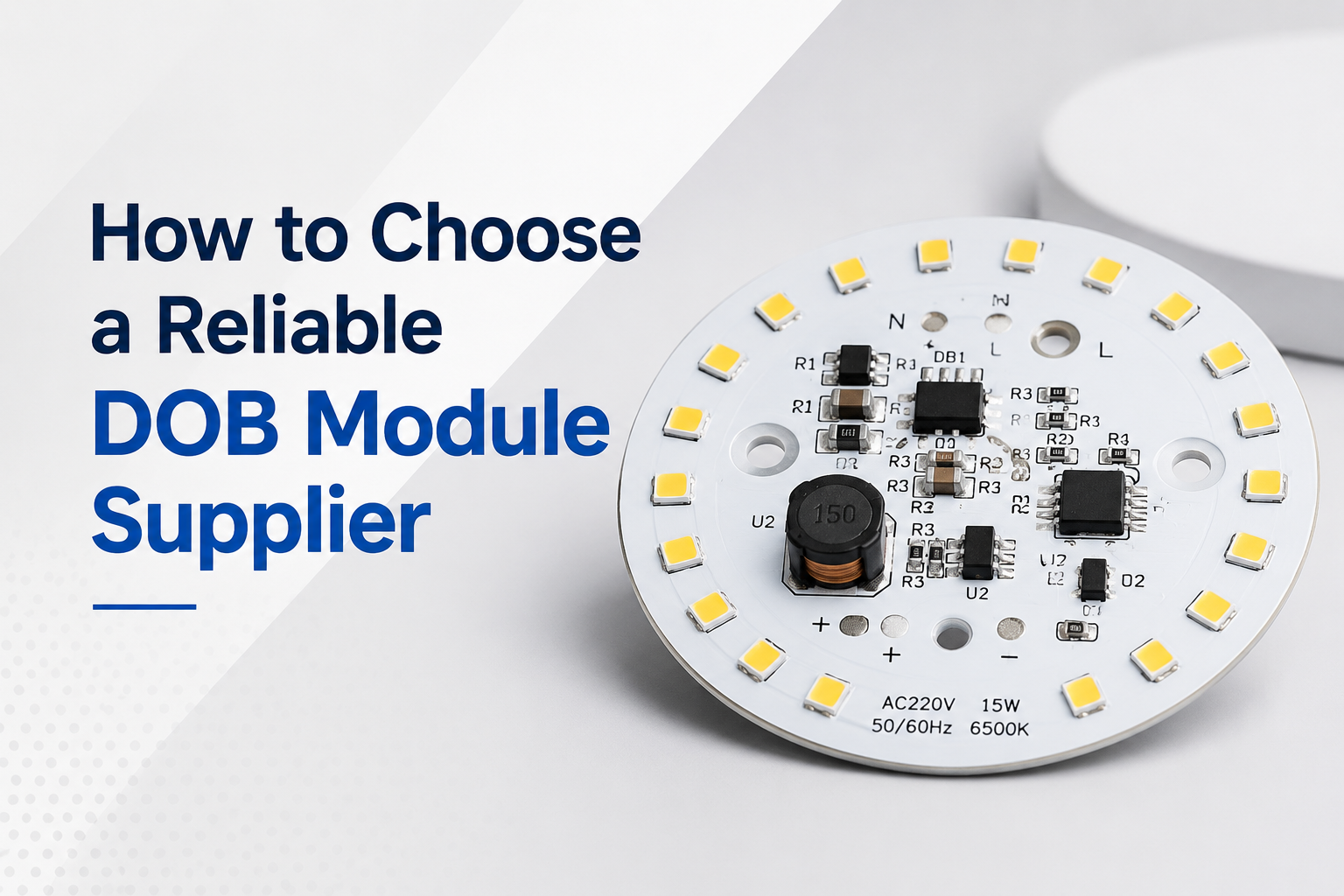
In today's highly competitive LED lighting industry, choosing a DOB module supplier is no longer simply about finding the lowest price. While inexpensive modules may reduce purchasing costs initially, problems such as unstable electrical performance, visible flicker, poor thermal management, inconsistent production quality, and delayed deliveries often create much higher costs over the product lifecycle.
For lighting manufacturers, wholesalers, importers, and OEM brands, a professional DOB module supplier should provide far more than PCB assembly. Strong engineering support, reliable quality control, customization capability, and responsive communication are all essential for long-term business success.
Whether you manufacture LED ceiling lights, panel lights, downlights, linear fixtures, or industrial luminaires, selecting the right supplier directly affects product reliability, customer satisfaction, and your company's reputation.
This guide explains the five most important factors every professional buyer should evaluate before choosing a DOB module supplier.
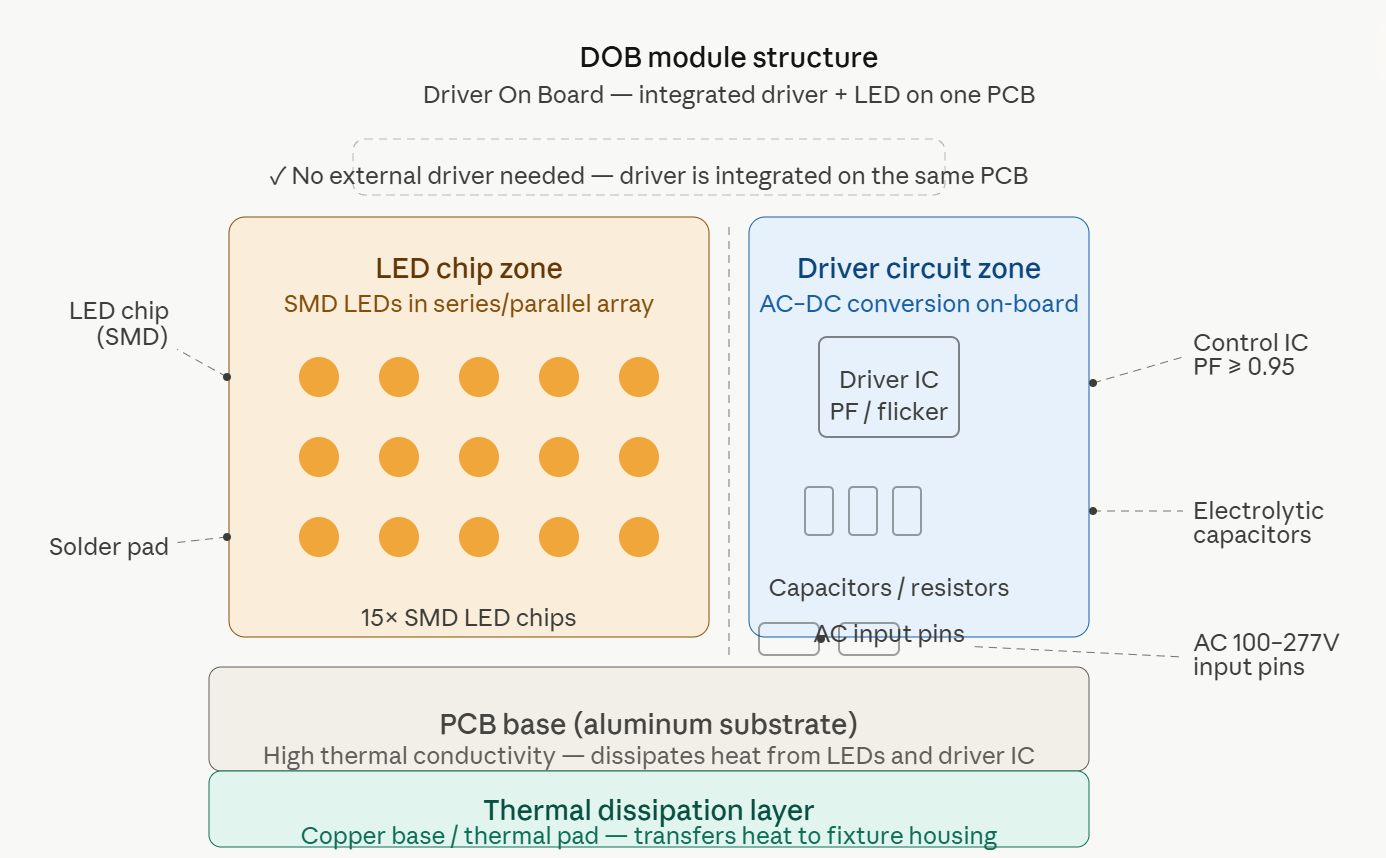
A DOB (Driver On Board) module integrates the LED driver circuit directly onto the PCB, eliminating the need for a separate external driver. This design reduces fixture size,
simplifies assembly, and lowers BOM cost for lighting manufacturers.
However, because the driver and LEDs share the same board, DOB module quality is highly sensitive to design precision,component selection, and thermal management. A poorly engineered DOB module will exhibit flicker, overheat, or fail prematurely — problems that are impossible to detect from a product photo or a low-price quotation alone.
This is why supplier evaluation goes far beyond price comparison.
Many suppliers can provide standard DOB boards, but far fewer can support real engineering requirements. A professional supplier should understand critical technical factors such as high PF design, flicker control, thermal management, and long-term stability.
In commercial lighting applications, poor DOB design may cause overheating, unstable brightness, or shortened product lifespan. Reliable suppliers usually have engineering teams capable of optimizing LED layouts, adjusting wattage solutions, and improving circuit performance according to customer requirements.
Instead of only asking for quotations, buyers should discuss technical details with suppliers. Questions about PF performance, flicker standards, thermal solutions, and aging tests can quickly reveal the supplier’s actual engineering capability.
A supplier with strong technical knowledge can help reduce future quality risks and improve overall product competitiveness.
What to ask during supplier evaluation:
What is the typical PF value of your DOB modules across different wattage ranges?
How do you achieve flicker control — which IC or topology do you use?
Can you provide aging test reports and thermal images from mass production batches?
A supplier who answers these questions precisely and confidently has real engineering depth. One who only sends a price list does not.
Many factories can produce impressive samples. Mass production consistency is the real test.
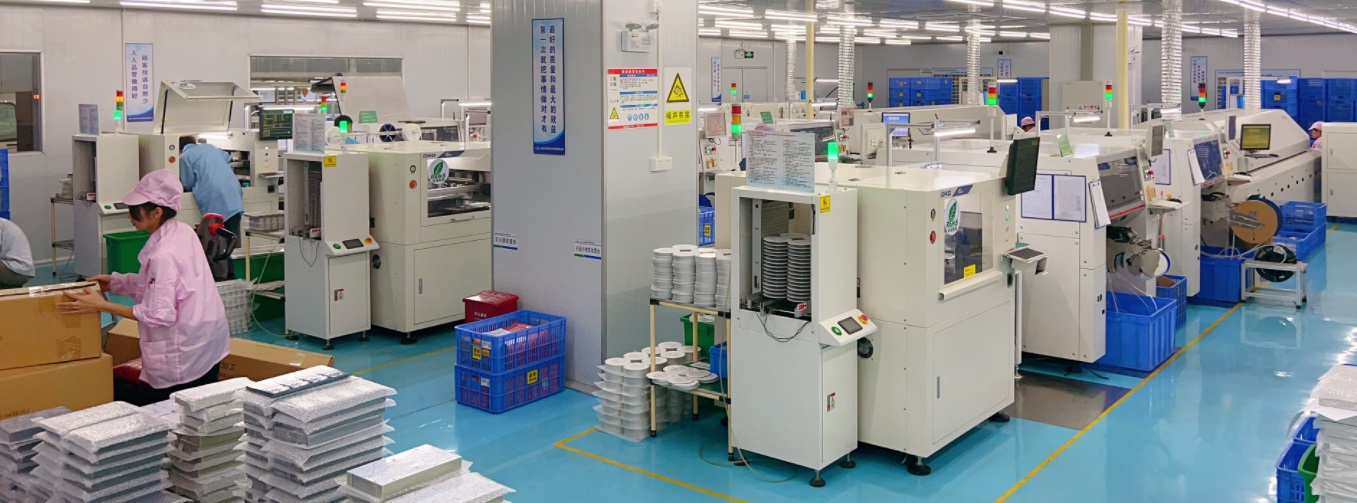
Professional DOB module manufacturers maintain strict control over SMT production, LED bin selection, soldering quality, and electrical testing. Stable batch consistency is especially important for large commercial lighting projects where brightness differences or inconsistent color temperatures create customer complaints and returns.
Reliable suppliers conduct multiple quality checks during production: AOI (Automated Optical Inspection), aging tests, and parameter verification before shipment. Ask for their standard QC process in writing.
For experienced buyers, stable batch quality is more valuable than the lowest unit price. A small saving per unit becomes meaningless when warranty issues or production delays arise at the customer's end.
Professional manufacturers usually implement strict quality management throughout the production process:
Incoming material inspection (IQC)
Automated Optical Inspection (AOI)
In-Circuit Testing (ICT)
Aging Test
Final Quality Control (FQC)
Stable production ensures every batch maintains consistent brightness, color temperature, PF, and electrical safety.
Flicker and heat are the two leading causes of DOB module failure in real-world applications.
Some low-cost suppliers advertise "high quality" products, but their modules show visible flicker or excessive temperature rise after extended operating hours. These problems often don't appear during brief sample testing — they emerge after weeks of continuous commercial use.
Professional suppliers pay close attention to LED chip spacing, PCB base material quality, IC layout, and heat dissipation design. Good thermal management directly improves lumen maintenance over time and extends product lifespan.
Low-flicker performance is increasingly critical for office lighting, retail environments, medical facilities, and any camera-sensitive application.
For example, a DOB module operating at 95°C may lose lumen output significantly faster than one operating at 75°C.
Better thermal management means:
Higher lumen maintenance
Longer LED lifetime
Lower driver stress
Better product reliability
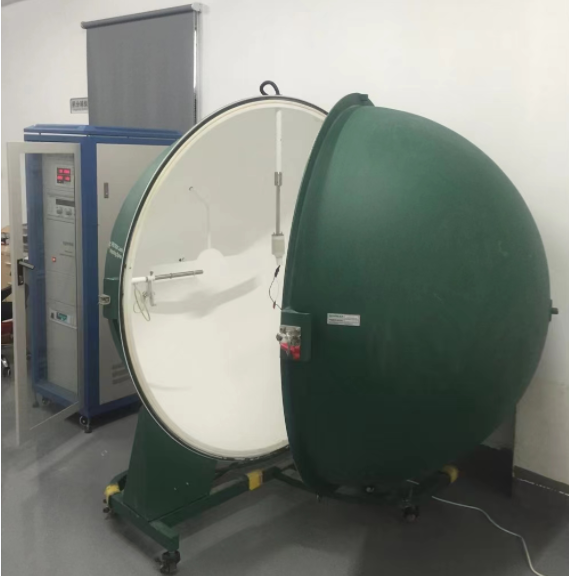
Professional suppliers usually provide thermal images, integrating sphere reports, and aging test reports to verify product performance.
Modern lighting markets require customized solutions, not just standard catalog products. A reliable DOB module supplier should support OEM and ODM projects: custom PCB sizes, wattage adjustments, LED arrangement optimization, CCT and CRI customization, and private label services.
Flexibility during product development reflects real technical strength. Suppliers who can quickly interpret your requirements and provide practical engineering suggestions are more valuable as long-term partners than factories that only ship standard SKUs.
For growing lighting brands, a supplier who supports customization helps you create differentiated products and move faster than competitors who rely on generic modules.
Many sourcing problems are caused not by products themselves, but by poor communication.
Reliable suppliers usually provide clear replies, organized technical documents, transparent delivery schedules, and honest feedback about production limitations. Professional communication becomes especially important during OEM projects or urgent production timelines.
Experienced buyers often evaluate suppliers based on response efficiency, problem-solving attitude, and communication clarity rather than price alone.
A dependable supplier should act like a long-term business partner, not simply a trading company sending quotations. Fast and accurate communication can significantly reduce project risks and improve overall cooperation efficiency.
In international B2B business, smooth communication is often one of the strongest signs of a professional supplier.
Use this table when comparing supplier datasheets or requesting samples. Key parameters to evaluate side by side:
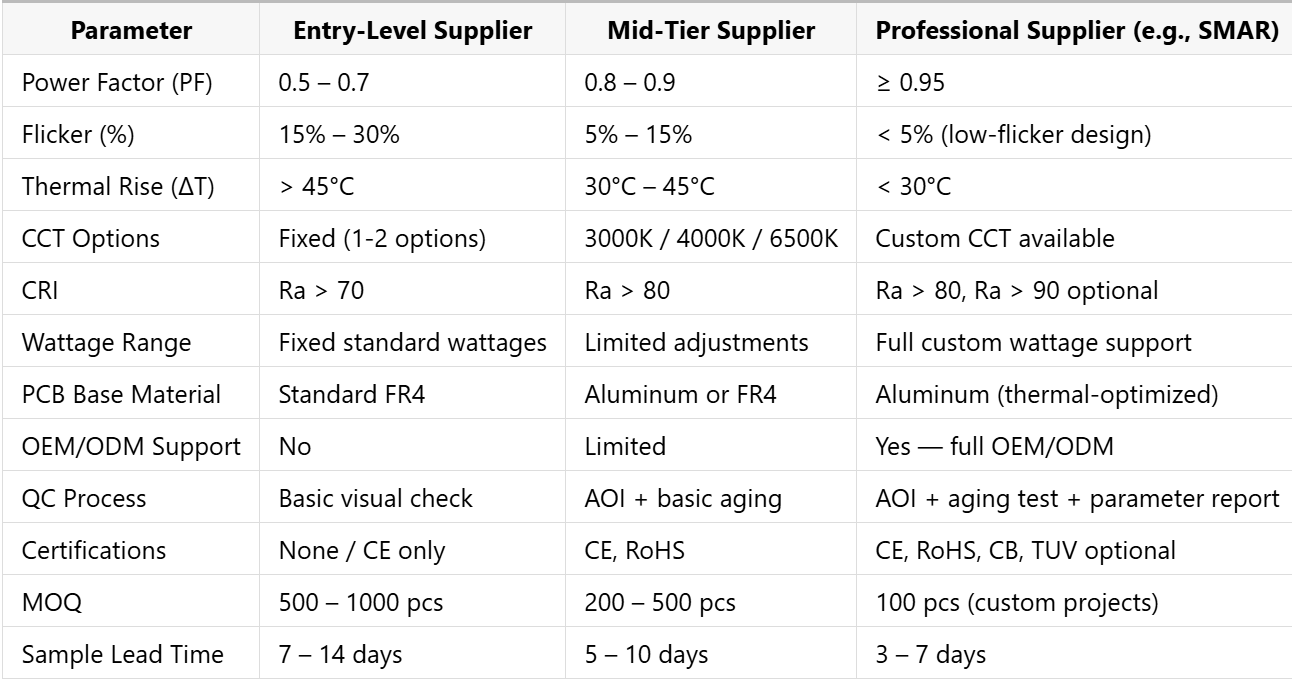
When reviewing supplier quotations, always request the actual measured values for PF, flicker, and thermal rise — not estimated or "typical" figures from a marketing brochure.
Office lighting requires high PF, low flicker, and excellent thermal performance to ensure visual comfort during long operating hours.
Cost-effective DOB modules with stable brightness are suitable for ceiling lights, downlights, and kitchen lighting.
Industrial environments demand higher reliability, better heat dissipation, and longer service life.
Retail stores often require high CRI and stable brightness to improve product presentation and customer experience.
Outdoor luminaires require excellent thermal performance and durable PCB materials to withstand harsh environments.
Q1. What is the most important factor when choosing a DOB module supplier?
Engineering capability and production consistency are usually more important than simply comparing prices.
Q2: How long does sample development take for a custom DOB module?
For minor adjustments to an existing design (wattage, CCT change), samples typically take 3–7 working days. For new PCB layouts or significantly modified designs, allow 10–15 working days. Confirm this timeline in writing before starting development.
Q3: How do I verify a supplier's flicker performance before ordering?
Request a flicker measurement report produced by a third-party lab or calibrated flicker meter — not a self-declared value. Ask the supplier to specify which measurement standard they use (IEC TR 61547-1, IEEE 1789, or Percent Flicker). If a supplier cannot provide a measurement report, treat that as a red flag.
Q4: Can DOB modules be customized for different input voltage ranges?
Yes. Professional suppliers can design DOB modules for specific input voltage ranges: 100–130V (North America), 200–240V (Europe/Australia), or universal 100–277V. Confirm the input voltage requirement clearly at the engineering discussion stage to avoid costly redesigns later.
Q5: What certifications should a DOB module have for export markets?
For Europe: CE marking and RoHS compliance are mandatory. For North America: UL or ETL certification is required for most commercial lighting applications. For Australia/New Zealand: SAA certification. For global projects, ask your supplier which certifications they can support and whether certification documentation covers your specific product configuration.
Q6: What causes DOB modules to fail prematurely in real applications?
The three most common causes are: (1) insufficient thermal management leading to high junction temperature in the LEDs, (2) capacitor degradation due to operating temperature above the component's rated specification, and (3) poor soldering quality causing cold joints that fail under thermal cycling. A supplier with strict production QC and proper thermal design should be able to demonstrate how their modules address all three.
Q7: Is it better to use a DOB module or a separate external driver?
DOB modules reduce fixture size, assembly complexity, and BOM cost — advantages that make them ideal for thin panel lights, downlights, and commercial fixtures where space is limited. External drivers offer more flexibility for dimming protocols (DALI, 0-10V) and easier replacement in the field. For most standard commercial applications, DOB modules are the more efficient and cost-effective choice.
Choosing a reliable DOB module supplier requires evaluating far more than unit pricing. Engineering expertise, production consistency, thermal management, customization capability, and efficient communication all play essential roles in long-term project success.
By partnering with a professional supplier, lighting manufacturers can reduce warranty costs, improve product performance, and strengthen their competitiveness in global markets.
SMAR LED Lighting specializes in OEM and ODM DOB module manufacturing for lighting brands and fixture manufacturers worldwide. Our engineering team supports custom wattage, CCT, PCB size, and performance optimization from sample to mass production.
View Our DOB Module Product Range → DOB Module Manufacturer | AC Direct Driver LED Module Supplier | SMAR
Learn More: DOB Module vs Traditional LED Driver → DOB Module vs Traditional LED Driver A Practical Guide for Lighting Manufacturers